Night Prayer
Traditional prayer of the Church. · The rights holder named on the source
Bless someone else by sharing this prayer.
Free to copy and share. Please credit lightofsaints.com.
Evening Prayer
(followed by an Act of Contrition)
O my God, at the end of this day I thank You most heartily for all the graces I have received from You.
I am sorry that I have not made a better use of them.
I am sorry for all the sins I have committed against You.
Forgive me, O my God, and graciously protect me this night.
Blessed Virgin Mary, my dear heavenly mother, take me under your protection.
St. Joseph, my dear Guardian Angel, and all you saints of God, pray for me.
Sweet Jesus, have pity on all poor sinners, and save them from hell.
Have mercy on the suffering souls in purgatory...
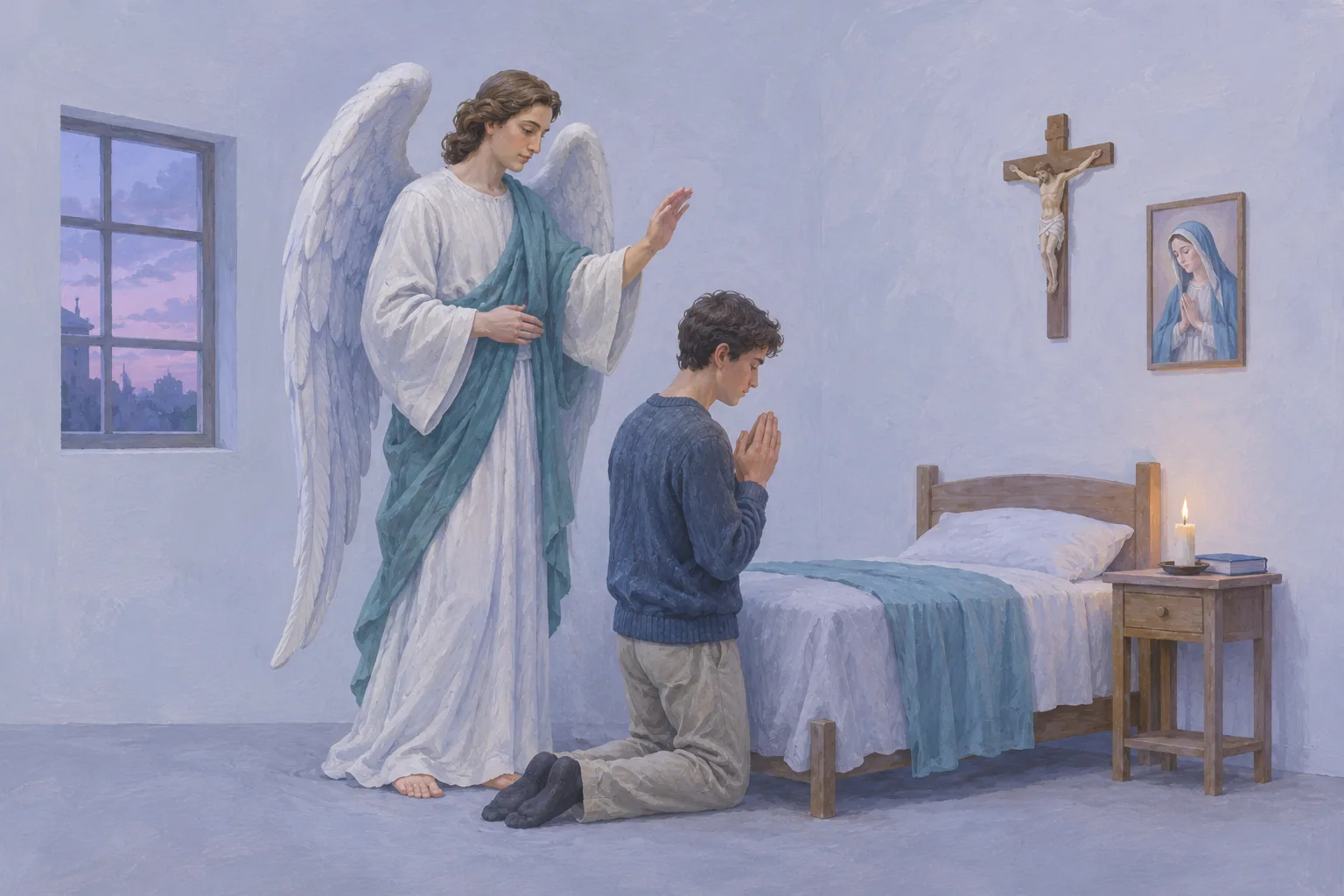
Meaning in brief
This prayer gives thanks for God's presence throughout the day, asks for the light of the Holy Spirit to recognize and be sorry for our sins, and asks for the protection of the angels and a blessing for the night. Its spirit is close to Psalm 4:9: we lie down in peace because it is the Lord who keeps us safe.
Intentions and hope
The faithful pray it to give thanks for the day that has passed, to ask forgiveness for their failings, and to ask for protection while they sleep. The prayer also makes room to pray for those who have died, hoping in the Lord's mercy for them.
When and how to pray
- Pray it as your last prayer before sleep, alone or with your family.
- Kneel or sit quietly, then begin with the Sign of the Cross.
- After the part giving thanks, pause for a moment to recall your thoughts, words, and actions of the day.
- In the last part, name those who have died whom you wish to pray for.
- You may close with a Hail Mary or the Hail, Holy Queen, and then the Sign of the Cross.
Where it comes from
History
This simple night prayer belongs to the Church's long custom of praying before sleep. In the official liturgy, the prayer that closes the day is called Completorium (in English, Compline), from a Latin word meaning the 'completion' of the day's work. According to the Catholic Encyclopedia (1913), the Rule of Saint Benedict from the early sixth century is the first text to use this name. [2]
Saint Benedict's Compline was short: three psalms (Psalms 4, 91, and 134 in today's numbering), a hymn, a short reading, the Kyrie eleison, a blessing, and a dismissal. Liturgical scholars do not agree on whether Benedict created it; some trace it to older origins. The 1913 encyclopedia places its roots in the early custom of praying before sleep, already known in the time of Clement of Alexandria and Cyprian. [2]
In the Middle Ages, this prayer moved from the monks' dormitory into the church and gained new elements, among them the confession of sins (the Confiteor), the Creed, the Our Father, the Hail Mary, and the Canticle of Simeon (Luke 2) as its Gospel canticle. [4]
The General Instruction of the Liturgy of the Hours (February 2, 1971) describes Night Prayer as the last prayer of the day, said before going to rest, even if it is already past midnight. It opens with a call asking for God's help, uses a one-week cycle of psalms and readings, and always ends with its appointed concluding prayer. [3][6]
Sources & version
Text: The rights holder named on the source. Checked word for word against the source on 2026-11-05.
- Evening Prayer - Prayers - Catholic Online
Text taken from www.catholic.org
Prayer text © The rights holder named on the source; quoted with attribution and a link (owner decision K2, ADR 0067).
- Compline (Complin) – Catholic Encyclopedia
Published by New Advent (Catholic Encyclopedia, 1913)
Cited as a factual source; the source text remains its publisher's.
- General Instruction on the Liturgy of the Hours (2 February 1971)
Published by EWTN Library (reproducing the Church document)
Cited as a factual source; the source text remains its publisher's.
- An Overview of Compline
Published by Concordia Publishing House blog (Lutheran)
Cited as a factual source; the source text remains its publisher's.
- Te Lucis Ante Terminum
Published by Encyclopedia.com
Cited as a factual source; the source text remains its publisher's.
- General Instructions (General Instruction of the Liturgy of the Hours)
Published by Divine Office
Cited as a factual source; the source text remains its publisher's.
Free to copy and share. Please credit lightofsaints.com. Copyright