Come, Holy Spirit (Pentecost Sequence)
Traditional prayer of the Church. · The rights holder named on the source
Bless someone else by sharing this prayer.
Free to copy and share. Please credit lightofsaints.com.
Pentecost Sunday Sequence
Come, Holy Spirit, come.
And from your celestial home
Shed a ray of light divine.
Come, Father of the poor.
Come, source of all our store.
Come, within our bosoms shine.
You, of comforters the best;
You, the soul’s most welcome guest;
Sweet refreshment here below;
In our labor, rest most sweet;
Grateful coolness in the heat;
Solace in the midst of woe.
O most blessed Light divine,
Shine within these hearts of yours,
And our inmost being fill.
Where you are not, we have naught,
Nothing good in deed or thought,
Nothing free from taint of ill.
Heal our wounds, our strength renew;
On our dryness pour your dew;
Wash the stains of guilt away:
Bend the stubborn heart and will;
Melt the frozen, warm the chill;
Guide the steps that go astray.
On the faithful, who adore
And confess you, evermore
In your sevenfold gift descend;
Give them virtue’s sure reward;
Give them your salvation, Lord;
Give them joys that never end.
Amen. Alleluia.
Latin text
Veni, Sancte Spiritus
Veni, Sancte Spiritus, et emitte caelitus lucis tuae radium.
Veni, pater pauperum, veni, dator munerum veni, lumen cordium.
Consolator optime, dulcis hospes animae, dulce refrigerium.
In labore requies, in aestu temperies in fletu solatium.
O lux beatissima, reple cordis intima tuorum fidelium.
Sine tuo numine, nihil est in homine, nihil est innoxium.
Lava quod est sordidum, riga quod est aridum, sana quod est saucium.
Flecte quod est rigidum, fove quod est frigidum, rege quod est devium.
Da tuis fidelibus, in te confidentibus, sacrum septenarium.
Da virtutis meritum, da salutis exitum, da perenne gaudium. Amen.
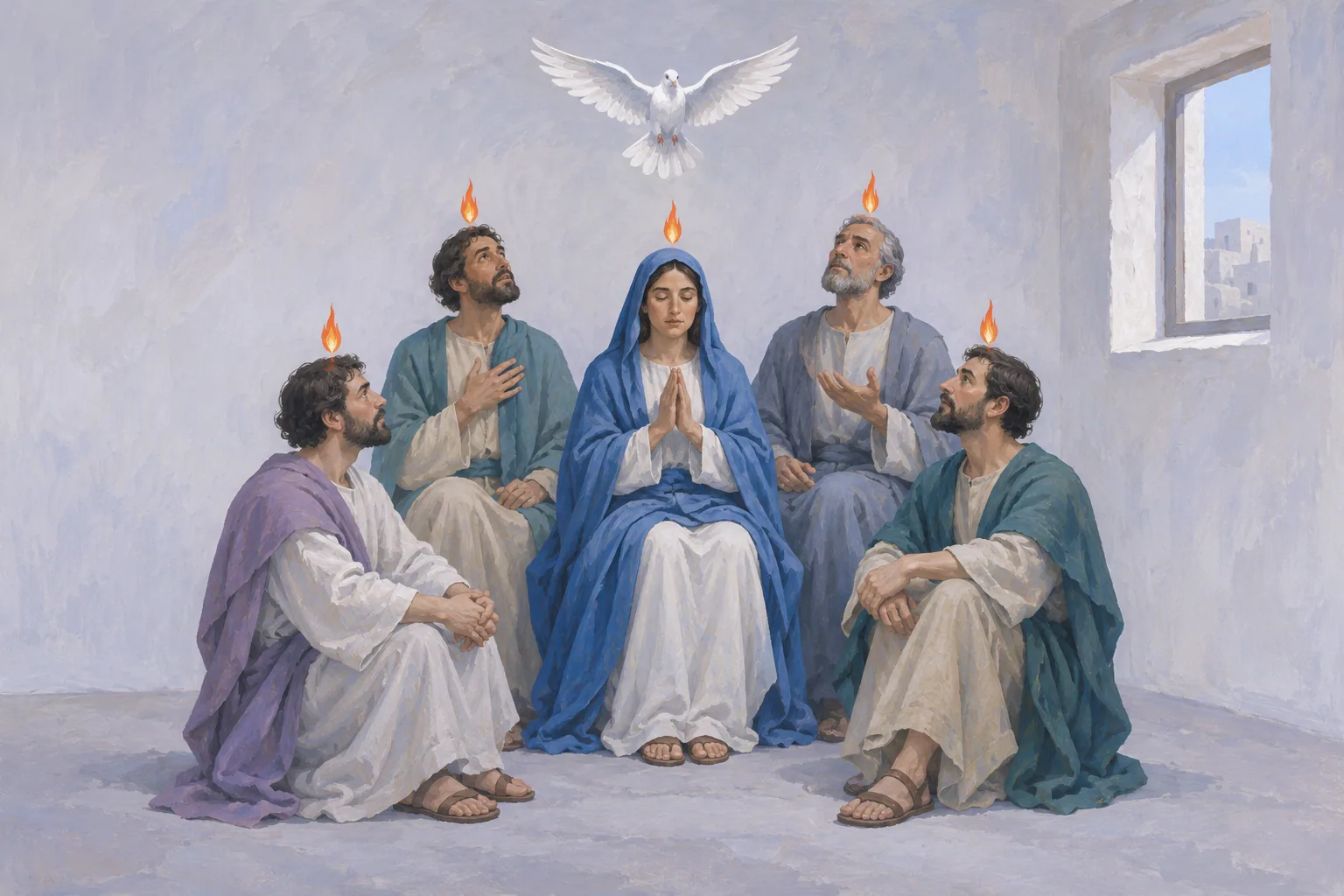
Meaning in brief
This prayer calls upon the Holy Spirit as Light, Father of the poor, and Comforter. It asks him to cleanse, heal and guide our hearts, and then to grant his seven gifts and a happy end to life (cf. John 14:26).
Intentions and hope
The faithful pray it to ask for the light of the Holy Spirit before studying, when they have to make a decision, or while preparing to receive the Sacrament of Confirmation. We may hope that our hearts become clearer, calmer and more open to God's will.
When and how to pray
- On the Solemnity of Pentecost, this sequence is required to be sung or recited at Mass before the Alleluia and the Gospel.
- Outside Mass, pray it on your own, sitting or kneeling quietly, and begin with the Sign of the Cross.
- Recite it slowly, stanza by stanza. Each stanza is one complete sentence, so we can pause for a moment to reflect on it.
- This prayer is well suited to praying before studying, before an exam, before making an important decision, or during the time of preparation for Confirmation.
- It can also be recited every day between the Ascension of the Lord and Pentecost, together with a novena to the Holy Spirit.
Where it comes from
History
This sequence is not found in any manuscript older than about the year 1200. In older books, it was added later by another hand. The sequence began to appear in liturgical books around the year 1200. [5]
The New Catholic Encyclopedia places it at the end of the 12th century, because its stanza form was not known before the middle of that century. According to the encyclopedia, the manuscript tradition shows that the sequence spread from Paris, not from Rome. [4]
Its author is not known for certain. A contemporary manuscript, thought to have been written by an English Cistercian monk, names Stephen Langton, Archbishop of Canterbury (died 1228). Modern scholars generally regard Langton as the most likely author. Pope Innocent III is the other main candidate. [4][6]
The Roman Missal as revised in 1570 assigned this sequence to the Solemnity of Pentecost and its octave. The revision of 1634 under Pope Urban VIII did not change that provision. [3]
Tradition · Medieval writers called it the "Golden Sequence" because of the richness of its content and the beauty of its expression. The sequence is made up of ten stanzas of three lines each. Each stanza is one complete sentence, and in Latin the third line of every stanza ends with the rhyme "-ium". [5][6][3]
Sources & version
Text: The rights holder named on the source. Checked word for word against the source on 2026-11-05.
- Pentecost Sunday Sequence
Text taken from www.marquette.edu
Prayer text © The rights holder named on the source; quoted with attribution and a link (owner decision K2, ADR 0067).
- Veni Sancte Spiritus - Hozana
Latin text from hozana.org
Latin text quoted with attribution and a link.
- Catholic Encyclopedia: Veni Sancte Spiritus Et Emitte Coelitus
Published by New Advent (Catholic Encyclopedia, 1913)
Cited as a factual source; the source text remains its publisher's.
- Veni Sancte Spiritus
Published by New Catholic Encyclopedia, via Encyclopedia.com
Cited as a factual source; the source text remains its publisher's.
- Veni, Sancte Spiritus (Come, Holy Spirit): The Golden Sequence
Published by Catholic Culture
Cited as a factual source; the source text remains its publisher's.
- Veni, Sancte Spiritus
Published by The Canterbury Dictionary of Hymnology
Cited as a factual source; the source text remains its publisher's.
Free to copy and share. Please credit lightofsaints.com. Copyright