Peace Prayer of Saint Francis
Traditional prayer of the Church. · The rights holder named on the source
Bless someone else by sharing this prayer.
Free to copy and share. Please credit lightofsaints.com.
Peace Prayer of Saint Francis
Lord, make me an instrument of your peace: where there is hatred, let me sow love; where there is injury, pardon; where there is doubt, faith; where there is despair, hope; where there is darkness, light; where there is sadness, joy.
O divine Master, grant that I may not so much seek, to be consoled as to console, to be understood as to understand, to be loved as to love.
For it is in giving that we receive, it is in pardoning that we are pardoned, and it is in dying that we are born to eternal life.
Amen.
Latin text
Oratio pacis
Domine, fac me instrumentum pacis tuae;
ut ubi odium est amorem inseram;
ut ubi iniuria est veniam inseram;
ut ubi discordia est concordiam inseram;
ut ubi error est veritatem inseram;
ut ubi dubium est fidem inseram;
ut ubi desperatio est spem inseram;
ut ubi tenebrae sunt lucem tuam inseram.
ut ubi tristitia est gaudium inseram;
Domine, fac ut magis quaeram consolare quam consolari;
ut magis quaeram intellegere quam intellegeri;
ut magis quaeram amare quam amari;
nam dando accepimus;
nam nos obliviscendo invenimus;
nam nos ignoscendo ignoscimur;
et moriendo ad aeternam vitam resuscitemur.
Amen.
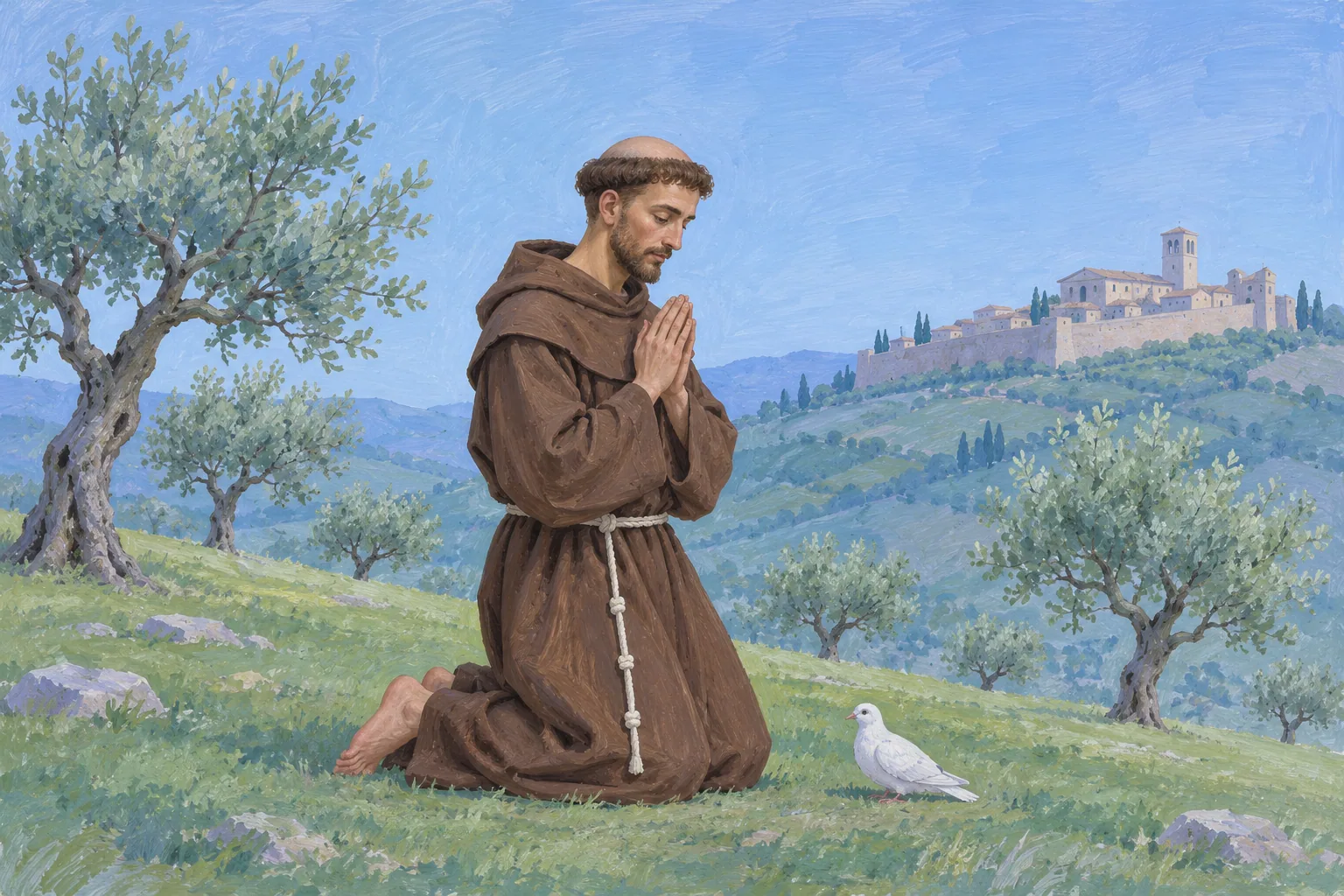
Meaning in brief
This prayer asks the Lord to make us instruments of his peace: bringing love where there is hatred, pardon where there is injury, and light where there is darkness. It echoes the words of Jesus, "Blessed are the peacemakers" (Mt 5:9), and invites us to want to give more than to receive.
Intentions and hope
The faithful pray it for peace in the world, for reconciliation in families or communities, and when the heart is gripped by anger or anxiety. What we may hope for is a heart that God slowly changes, so that we become more patient, quicker to forgive, and more caring toward others.
When and how to pray
- Pray it in the morning to begin the day intending to bring peace, or in the evening while looking back over the day that has passed.
- Settle into a calm posture, sitting or kneeling, and begin with the Sign of the Cross.
- Say the prayer slowly; pause for a moment on the line that speaks most to your situation right now.
- This prayer can also be recited together in a group or sung.
- In particular, many of the faithful pray it on the feast of Saint Francis of Assisi (October 4) and in times of war or conflict.
Where it comes from
History
The oldest known printing of this prayer appeared in December 1912 in La Clochette, a small Paris magazine belonging to La Ligue de la Sainte-Messe. The prayer was published without an author's name under the title "Belle prière à faire pendant la messe" (A beautiful prayer to pray during Mass). [3][4]
La Ligue de la Sainte-Messe was founded in 1901 by Father Esther Bouquerel (1855–1923). It is possible that he wrote the prayer himself, but no document proves it. [3]
In 1915 the Marquis Stanislas de La Rochethulon sent the prayer in French to Pope Benedict XV. In 1916 it was published in Italian in L'Osservatore Romano. Around 1920, a French Franciscan priest printed it on the back of a picture of Saint Francis under the title "Prière pour la paix", without naming Francis as its author. This is most likely where the prayer's link with Saint Francis began. [4][5]
The prayer is not found in the authentic writings of Saint Francis of Assisi. Franciscan scholars such as Kajetan Esser have stated that it is clearly not his work. The prayer was first attributed to Francis in 1927 by the French Protestant movement Les Chevaliers du Prince de la Paix, and the first known English translation (1936, in a book by Kirby Page) also named Francis as its author. [3][4][5][6]
During and after World War II, the prayer spread widely as the "Prayer of Saint Francis", in part through books and through Cardinal Francis Spellman, Archbishop of New York, who distributed it. Although Saint Francis did not write it, the prayer is linked with him because it reflects his spirit. [5][7]
Sources & version
Text: The rights holder named on the source. Checked word for word against the source on 2026-11-05.
- Prayer Card – Prayer of Saint Francis of Assisi (Jubilee)
Text taken from hamiltondiocese.com
Prayer text © The rights holder named on the source; quoted with attribution and a link (owner decision K2, ADR 0067).
- The Origin and Original Text of the Peace Prayer of St. Francis
Published by Franciscan Archive (reproduces Christian Renoux's findings)
Cited as a factual source; the source text remains its publisher's.
- The Origin Of The Peace Prayer Of St. Francis
Published by silkworth.net (mirror of the Renoux text; cites La Clochette no. 12, Dec. 1912, p. 285)
Cited as a factual source; the source text remains its publisher's.
- A Look at the Peace Prayer of St. Francis
Published by Franciscan Media
Cited as a factual source; the source text remains its publisher's.
- The Story behind the Peace Prayer of St. Francis
Published by Franciscan Archive
Cited as a factual source; the source text remains its publisher's.
- Peace Prayer attributed to St. Francis because it reflects his spirit
Published by dolr.org (diocesan Catholic article)
Cited as a factual source; the source text remains its publisher's.
Free to copy and share. Please credit lightofsaints.com. Copyright