The Apostles' Creed
Traditional prayer of the Church. · USCCB / ICEL
Bless someone else by sharing this prayer.
Free to copy and share. Please credit lightofsaints.com.
The Apostles' Creed
I believe in God,
the Father almighty,
Creator of heaven and earth,
and in Jesus Christ, his only Son, our Lord,
who was conceived by the Holy Spirit,
born of the Virgin Mary,
suffered under Pontius Pilate,
was crucified, died and was buried;
he descended into hell;
on the third day he rose again from the dead;
he ascended into heaven,
and is seated at the right hand of God the Father almighty;
from there he will come to judge the living and the dead.
I believe in the Holy Spirit,
the holy catholic Church,
the communion of saints,
the forgiveness of sins,
the resurrection of the body,
and life everlasting.
Amen.
Latin text
Symbolum Apostolicum
Credo in Deum
Patrem omnipotentem,
Creatorem caeli et terrae,
et in Iesum Christum, Filium Eius
unicum,
Dominum nostrum,
qui conceptus est de Spiritu Sancto,
natus ex Maria Virgine,
passus sub Pontio Pilato,
crucifixus, mortuus,
et sepultus,
descendit ad inferos,
tertia die resurrexit a mortuis,
ascendit ad caelos,
sedet ad dexteram Patris
omnipotentis,
inde venturus est iudicare vivos et
mortuos.
Credo in Spiritum Sanctum,
sanctam Ecclesiam catholicam,
sanctorum communionem,
remissionem peccatorum,
carnis resurrectionem,
vitam aeternam.
Amen
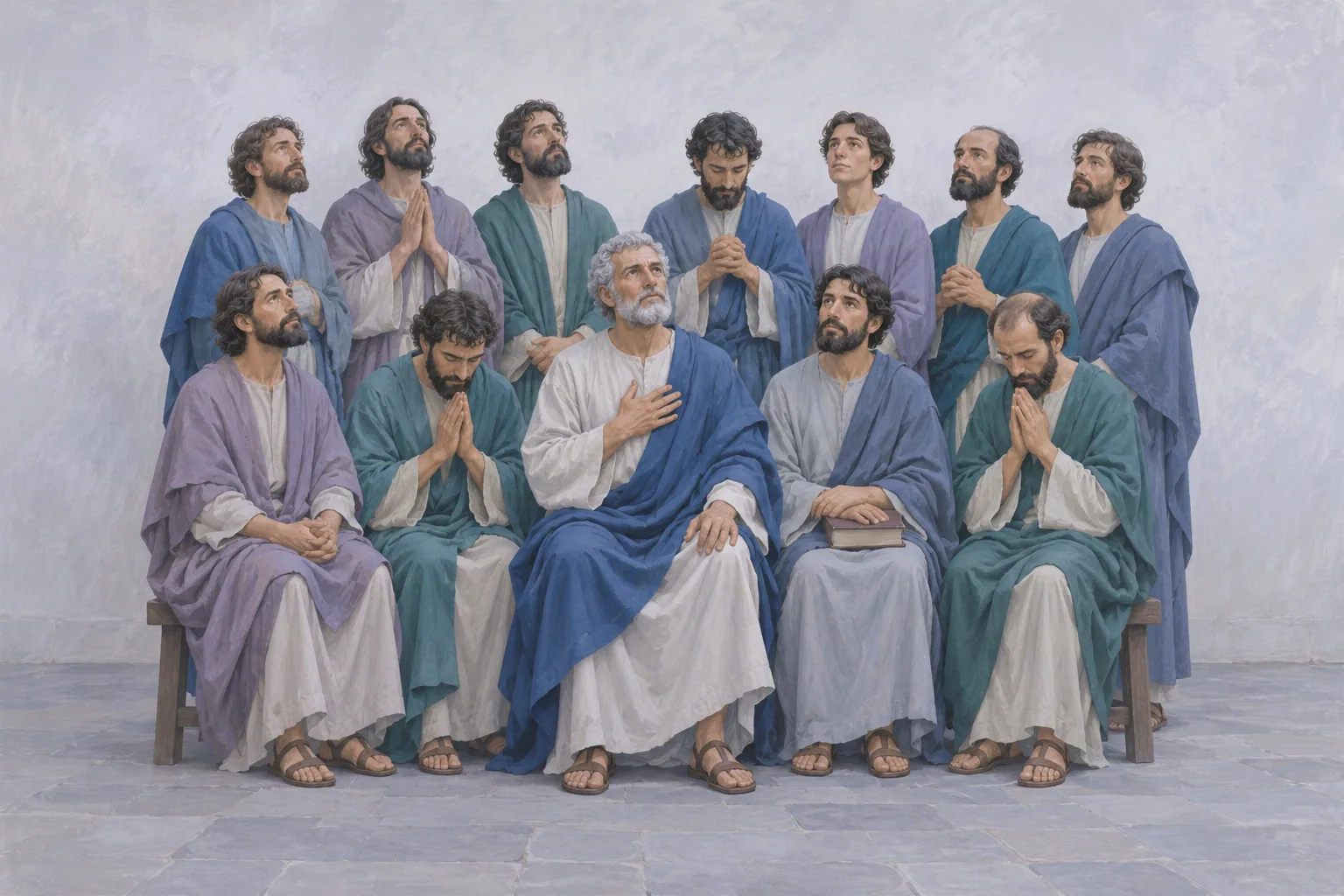
Meaning in brief
This creed professes faith in God the Father, the Creator; in Jesus Christ, who died and rose again; and in the Holy Spirit, who is at work in the Church. Its threefold structure follows Jesus' command to baptize "in the name of the Father, and of the Son, and of the Holy Spirit" (Mt 28:19).
Intentions and hope
The faithful pray it to profess and strengthen their personal faith, especially when faith feels shaky. It also recalls our baptismal promises and unites the one who prays with the faith of the Church through the ages.
When and how to pray
- Begin with the Sign of the Cross and quiet yourself for a moment.
- Say it slowly, as a personal profession of faith, whether standing or kneeling.
- Pray it in the morning or at night as part of your daily prayer.
- In the Rosary, it is the opening prayer, said before the Our Father and three Hail Marys.
- At Mass, the Apostles' Creed may be used in place of the Niceno-Constantinopolitan Creed.
- For reflection, take one part (about the Father, the Son, or the Holy Spirit) and ponder its meaning.
Where it comes from
History
This creed grew out of the profession of faith made at baptism. Its shorter ancestor, the Old Roman Creed, developed from a simple Trinitarian formula rooted in Matthew 28:19. Some scholars hold that a written form already existed by the late 2nd century, but others doubt so early a date. [5][6]
The Old Roman form is preserved in Greek in a letter of Marcellus of Ancyra (around 340), and in Latin in the commentary of Rufinus of Aquileia (around 390–404), who compared the Roman creed with the creed of his own Church of Aquileia. The name "Apostles' Creed" (Symbolum Apostolorum) first appears in a letter of the Synod of Milan in 390, which still refers to the Old Roman Creed, not yet to the final text. [4][5][6]
The Old Roman Creed remained the standard liturgical creed of the Church of Rome from the 4th to the 7th century; similar creeds in Milan and Gaul differed only slightly. The fuller text used today is first quoted in the Scarapsus of Pirminius of Reichenau (written between 710 and 724). This text adds, among other things, "he descended into hell", "the communion of saints" and "life everlasting", and probably came from southern Gaul or Spain rather than from Rome. [4][5]
The Creed entered the Liturgy of the Hours fairly early. Fructuosus of Braga (died 665) placed it in Compline. Benedict of Aniane (died 821) and Amalarius of Metz asked that the Creed be said before Matins and Prime and after Compline. [4]
Tradition · The Catechism of the Catholic Church (nos. 194 and 196) explains that this Creed is called the Apostles' Creed because it is a faithful summary of the apostles' faith. The Catechism calls it the ancient baptismal symbol of the Church of Rome and "the oldest Roman catechism", and uses it as its guide in setting out the faith. The Catechism (no. 191) also mentions the ancient custom, attested by Saint Ambrose, of counting twelve articles of faith as a symbol of the fullness of the apostles' faith. [3]
Sources & version
Text: USCCB / ICEL. Checked word for word against the source on 2026-11-05.
- Apostles' Creed
Text taken from www.usccb.org
Prayer text © USCCB / ICEL; quoted with attribution and a link (owner decision K2, ADR 0067).
- Catechismus Catholicae Ecclesiae - Credimus
Latin text from www.vatican.va
Latin text quoted with attribution and a link.
- Catechism of the Catholic Church, Part One, Section Two: The Creeds (nos. 189–197)
Published by Vatican (Libreria Editrice Vaticana)
Cited as a factual source; the source text remains its publisher's.
- Apostles' Creed
Published by Encyclopedia.com (New Catholic Encyclopedia)
Cited as a factual source; the source text remains its publisher's.
- Apostles' Creed
Published by Wikipedia
Cited as a factual source; the source text remains its publisher's.
- Apostles' Creed
Published by BiblicalTraining
Cited as a factual source; the source text remains its publisher's.
Free to copy and share. Please credit lightofsaints.com. Copyright