The Magnificat
Traditional prayer of the Church. · The rights holder named on the source
Bless someone else by sharing this prayer.
Free to copy and share. Please credit lightofsaints.com.
Canticle Of Mary
My soul proclaims the greatness of the Lord,
My Spirit rejoices in God my Saviour
For He has looked with favour on His lowly servant.
From this day all generations will call me blessed:
The Almighty has done great things for me,
And holy is His Name.
He has mercy on those who fear Him
In every generation.
He has shown the strength of His arm,
He has scattered the proud in their conceit.
He has cast down the mighty from their thrones,
And has lifted up the lowly.
He has filled the hungry with good things,
And the rich He has sent away empty.
He has come to the help of His servant Israel
For He has remembered His promise of mercy,
The promise He made to our fathers,
To Abraham and his children for ever.
Glory to the Father,
and to the Son,
and to the Holy Spirit.
As it was in the beginning.
is now, and will be forever.
Amen.
Latin text
Magnificat
Magnificat anima mea Dominum;
Et exultavit spiritus meus in Deo salutari meo,
Quia respexit humilitatem ancillae suae; ecce enim ex hoc beatam me dicent omnes generationes.
Quia fecit mihi magna qui potens est, et sanctum nomen ejus, Et misericordia ejus a progenie in progenies timentibus eum.
Fecit potentiam brachio suo;
Dispersit superbos mente cordis sui.
Deposuit potentes de sede, et exaltavit humiles.
Esurientes implevit bonis, et divites dimisit inanes.
Sucepit Israel, puerum suum, recordatus misericordiae suae, Sicut locutus est ad patres nostros, Abraham et semeni ejus in saecula.
Meaning in brief
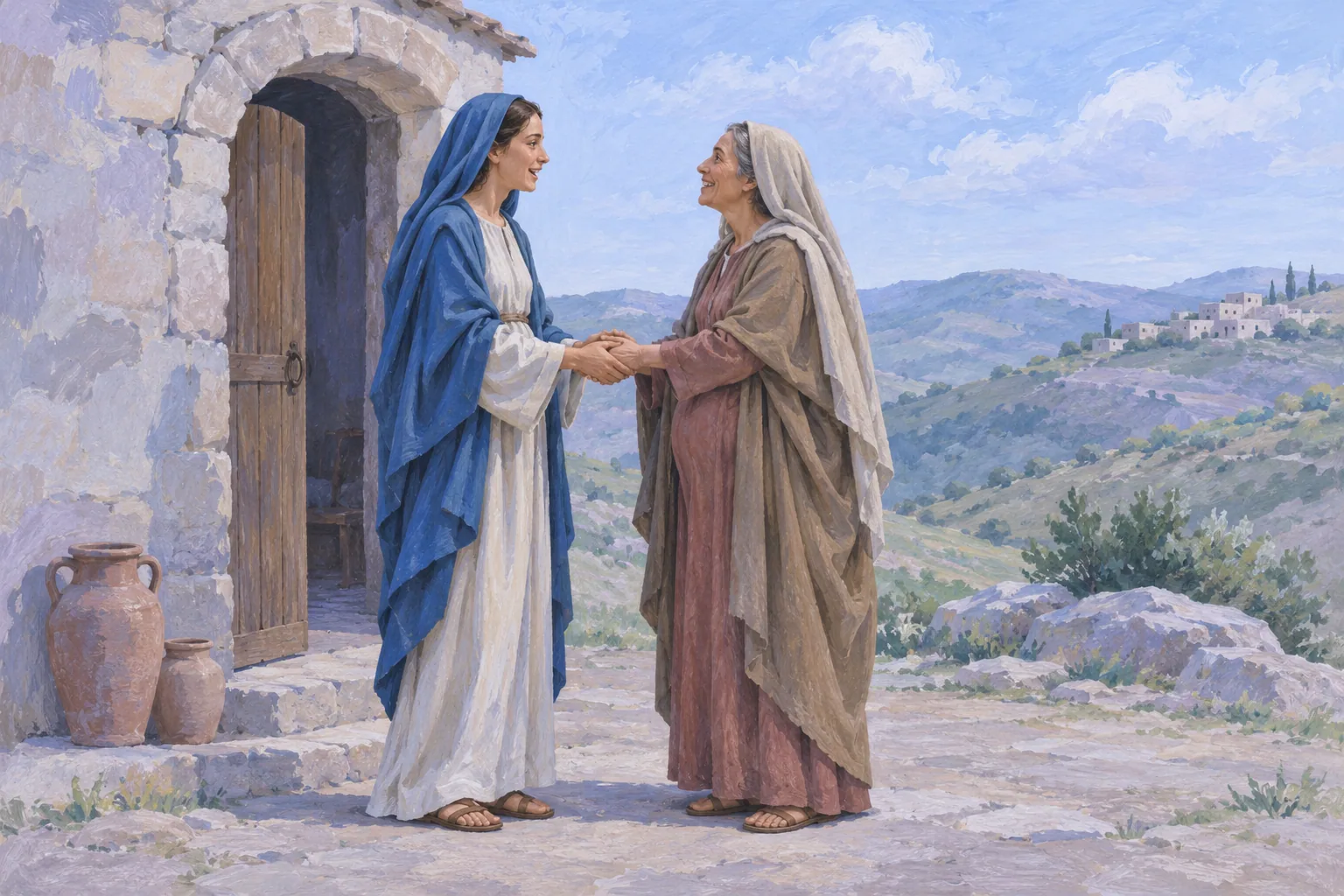
In this canticle (Luke 1:46-55), Mary proclaims the greatness of God, who has looked with favour on His lowly servant and has done great things for her. She praises God who is faithful to His promise to Abraham, who scatters the proud, and who lifts up the lowly and the hungry.
Intentions and hope
People pray the Magnificat to give thanks for God's goodness in their own lives and in the history of His people. This canticle also invites us to hope together with the little ones and the poor, and to learn to be humble before God as Mary was.
When and how to pray
- Pray this canticle at Evening Prayer (Vespers), usually around sunset; on Sundays and solemnities there are two Evening Prayers.
- In the Liturgy of the Hours, the canticle is framed by an antiphon that changes with the feast or liturgical season, and it ends with the Glory Be.
- When praying it on your own, first read the story of Mary's visit to Elizabeth in Luke 1:39-56.
- Say or sing the canticle slowly as a prayer of thanksgiving, recalling God's goodness to you that day.
Where it comes from
History
The Magnificat is the song of the Blessed Virgin Mary in the Gospel of Luke 1:46-55. Mary spoke it when she visited her relative Elizabeth and was welcomed by her. The canticle is recorded only in the Gospel of Luke. [4]
The name Magnificat comes from the first word of the Latin Vulgate text, "Magnificat anima mea Dominum," which means "My soul proclaims the greatness of the Lord." [3][6]
Three ancient Latin manuscripts (Vercellensis, Veronensis and Rhedigerianus) have "And Elizabeth said" before the canticle. The Catholic Encyclopedia (1913) mentions this as material for what was then a new discussion about who spoke the canticle. The Church's liturgy and the Catechism of the Catholic Church treat it as Mary's canticle. [3][5]
In the Western Church, the Magnificat has been the canticle of Evening Prayer from early times, while some Eastern liturgies use it in morning prayer. According to one study, its use at Evening Prayer is already recorded in the Rule of Saint Benedict. When it is prayed in the Liturgy of the Hours, the canticle ends with the Glory Be, which is not part of the text of Luke's Gospel. [4][6][7]
The Catechism of the Catholic Church (no. 2619) calls the Magnificat, or the Megalynei in the Byzantine tradition, the song both of the Mother of God and of the Church. The Catechism also calls it the song of the Daughter of Zion, the song of thanksgiving for the fullness of graces, and the song of the "poor" whose hope is fulfilled. [5]
Sources & version
Text: The rights holder named on the source. Checked word for word against the source on 2026-11-05.
- Canticle Of Mary - Prayers - Catholic Online
Text taken from www.catholic.org
Prayer text © The rights holder named on the source; quoted with attribution and a link (owner decision K2, ADR 0067).
- The Magnificat - The Prayer of Mary
Latin text from www.ewtn.com
Latin text quoted with attribution and a link.
- Magnificat
Published by Catholic Answers (reprint of the Catholic Encyclopedia, 1913)
Cited as a factual source; the source text remains its publisher's.
- Magnificat (Canticle of Mary)
Published by New Catholic Encyclopedia, via Encyclopedia.com
Cited as a factual source; the source text remains its publisher's.
- Catechism of the Catholic Church, no. 2619
Published by USCCB
Cited as a factual source; the source text remains its publisher's.
- Magnificat, the Canticle of Mary: A Theological Analysis
Published by Locus Mariologicus
Cited as a factual source; the source text remains its publisher's.
- The Canticle of Mary
Published by National Shrine of Mary, Mother of the Church
Cited as a factual source; the source text remains its publisher's.
Free to copy and share. Please credit lightofsaints.com. Copyright