The Memorare
Traditional prayer of the Church. · The rights holder named on the source
Bless someone else by sharing this prayer.
Free to copy and share. Please credit lightofsaints.com.
Memorare
Remember, O most gracious Virgin Mary, that never was it known that anyone who fled to thy protection, implored thy help, or sought thy intercession, was left unaided.
Inspired by this confidence I fly unto thee, O Virgin of virgins, my Mother.
To thee do I come, before thee I stand, sinful and sorrowful.
O Mother of the Word Incarnate, despise not my petitions, but in thy mercy hear and answer me.
Amen.
Latin text
Memorare
MEMORARE, O piissima Virgo Maria, non esse auditum a saeculo, quemquam ad tua currentem praesidia, tua implorantem auxilia, tua petentem suffragia, esse derelictum.
Ego tali animatus confidentia, ad te, Virgo Virginum, Mater, curro, ad te venio, coram te gemens peccator assisto.
Noli, Mater Verbi, verba mea despicere; sed audi propitia et exaudi.
Amen.
Meaning in brief
This prayer reminds the Blessed Virgin Mary that never was it known that anyone who fled to her protection was left unaided. Inspired by this confidence, the one praying comes before her as a sinner and asks the Mother of the Word Incarnate not to despise their petitions, but to hear their prayer.
Intentions and hope
Catholics pray it in times of personal need, worry, illness or danger, and also as a closing prayer for devotions to Mary. What we may hope for is to be accompanied by the prayer of the Blessed Virgin Mary, who leads us to her Son, while we keep entrusting ourselves to God's will.
When and how to pray
- Find a quiet place; you may kneel, sit or stand before a picture or statue of the Blessed Virgin Mary.
- Begin with the Sign of the Cross and name silently the intention or need you want to bring to the Blessed Virgin Mary.
- Pray the Memorare slowly once, paying attention to each sentence.
- This prayer is often said after the Rosary, but it can also be prayed at any time, including in moments of worry or danger.
- Close with a Hail Mary or a Glory Be and the Sign of the Cross.
Where it comes from
History
The oldest traceable form of the Memorare is not a stand-alone prayer. Its text is contained in a longer Latin prayer to Mary, "Ad sanctitatis tuae pedes, dulcissima Virgo Maria", which is found in printed books and manuscripts from the last quarter of the 15th century onward. [3]
According to the New Catholic Encyclopedia, the manuscript tradition of this prayer can be traced back only to the 15th century. The encyclopedia mentions the Antidotarius animae by Nicolas Salicetus (1489) and the Hortulus animae published by J. Wellinger (1503), which may already have contained it as a separate invocation. [4]
The author of this prayer is unknown. It has been attributed to Saint Augustine, Saint John Chrysostom and Saint Bernard of Clairvaux. Some passages in Saint Bernard's sermons do echo its theme, but none comes close to the words of the Memorare. Scholars usually explain the attribution to Saint Bernard as a confusion of names with Father Claude Bernard; Bishop Hefele, for example, suggested that the name "Bernard" was mixed up because the names are alike. [4][3]
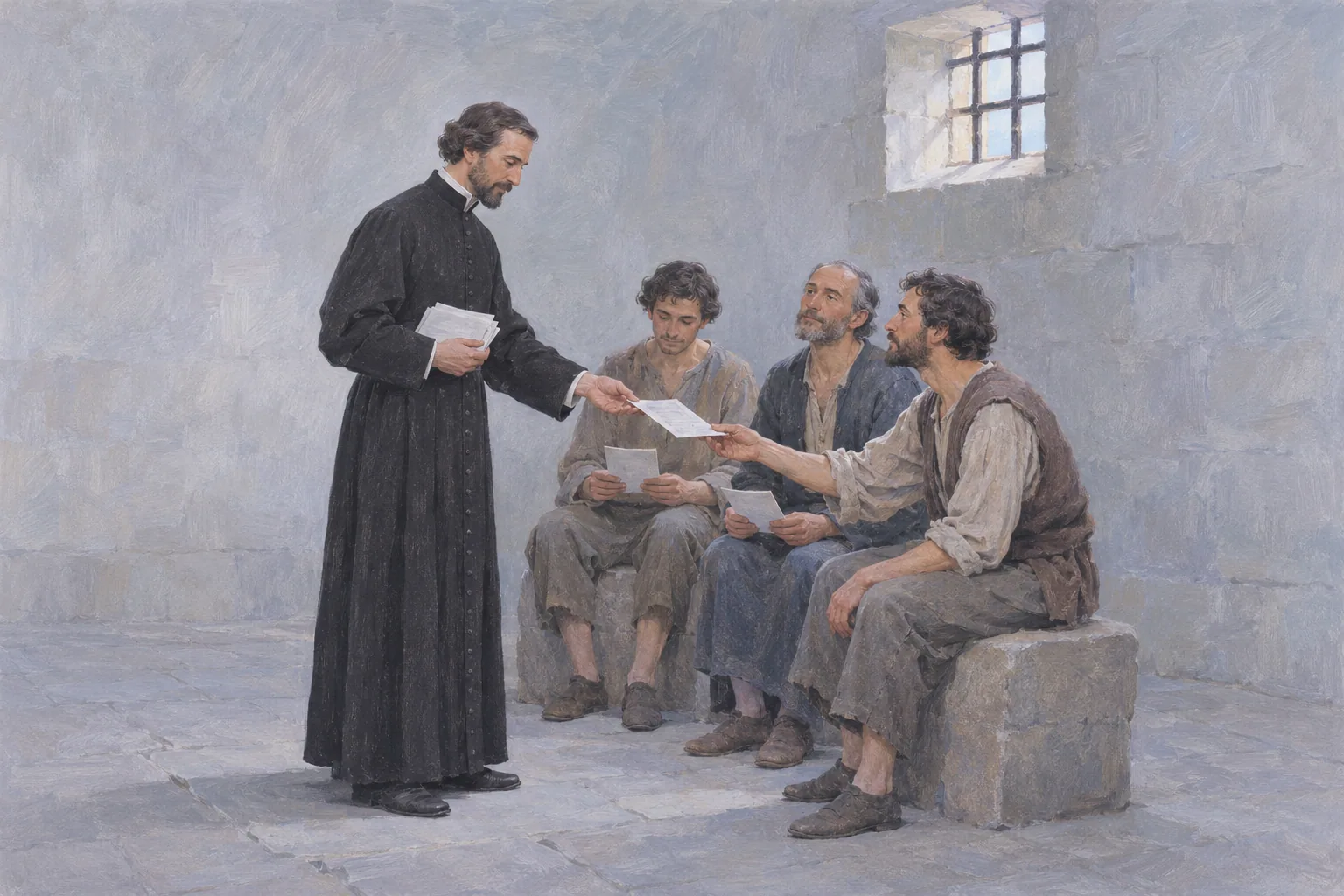
Father Claude Bernard (1588–1641), a French priest known as "the poor priest", made this prayer popular. He ministered to prisoners, including those condemned to death, and is said to have handed out more than 200,000 printed copies in several languages. He himself stated that he had learned the prayer from his father. [3]
The text known today is the form granted an indulgence by Pope Pius IX in 1846. According to the New Catholic Encyclopedia, the prayer first appeared in the Raccolta, the collection of indulgenced prayers approved by the Holy See, in its 12th edition (Rome, 1849). The 1866 English Raccolta granted an indulgence of 300 days to those who pray it with a contrite heart and called it the prayer of "Saint Bernard". In England, the Memorare became a prayer loved by Catholics especially after 1850. [3][4]
Sources & version
Text: The rights holder named on the source. Checked word for word against the source on 2026-11-05.
- Memorare
Text taken from www.usccb.org
Prayer text © The rights holder named on the source; quoted with attribution and a link (owner decision K2, ADR 0067).
- Memorare, O piissima Virgo Maria
Latin text from www.preces-latinae.org
Latin text quoted with attribution and a link.
- Memorare (New Catholic Encyclopedia entry)
Published by Encyclopedia.com / New Catholic Encyclopedia
Cited as a factual source; the source text remains its publisher's.
Free to copy and share. Please credit lightofsaints.com. Copyright