The Confiteor (I Confess)
Traditional prayer of the Church; text: The Order of Mass, USCCB text for the Roman Missal, Third Edition. · USCCB / ICEL
Bless someone else by sharing this prayer.
Free to copy and share. Please credit lightofsaints.com.
I Confess
Then all recite together the formula of general confession:
I confess to almighty God and to you, my brothers and sisters, that I have greatly sinned,
in my thoughts and in my words, in what I have done and in what I have failed to do,
Striking the breast
And, striking their breast, they say:
through my fault, through my fault, through my most grievous fault;
Petition
Then they continue:
therefore I ask blessed Mary ever-Virgin, all the Angels and Saints, and you, my brothers and sisters, to pray for me to the Lord our God.
Latin text
Confiteor
Confiteor Deo omnipotenti,
et vobis, fratres,
quia peccavi nimis cogitatione, verbo, opere et omissione:
mea culpa, mea culpa, mea maxima culpa.
Ideo precor beatam Mariam semper Virginem,
omnes Angelos et Sanctos,
et vos, fratres,
orare pro me ad Dominum Deum nostrum. Amen.
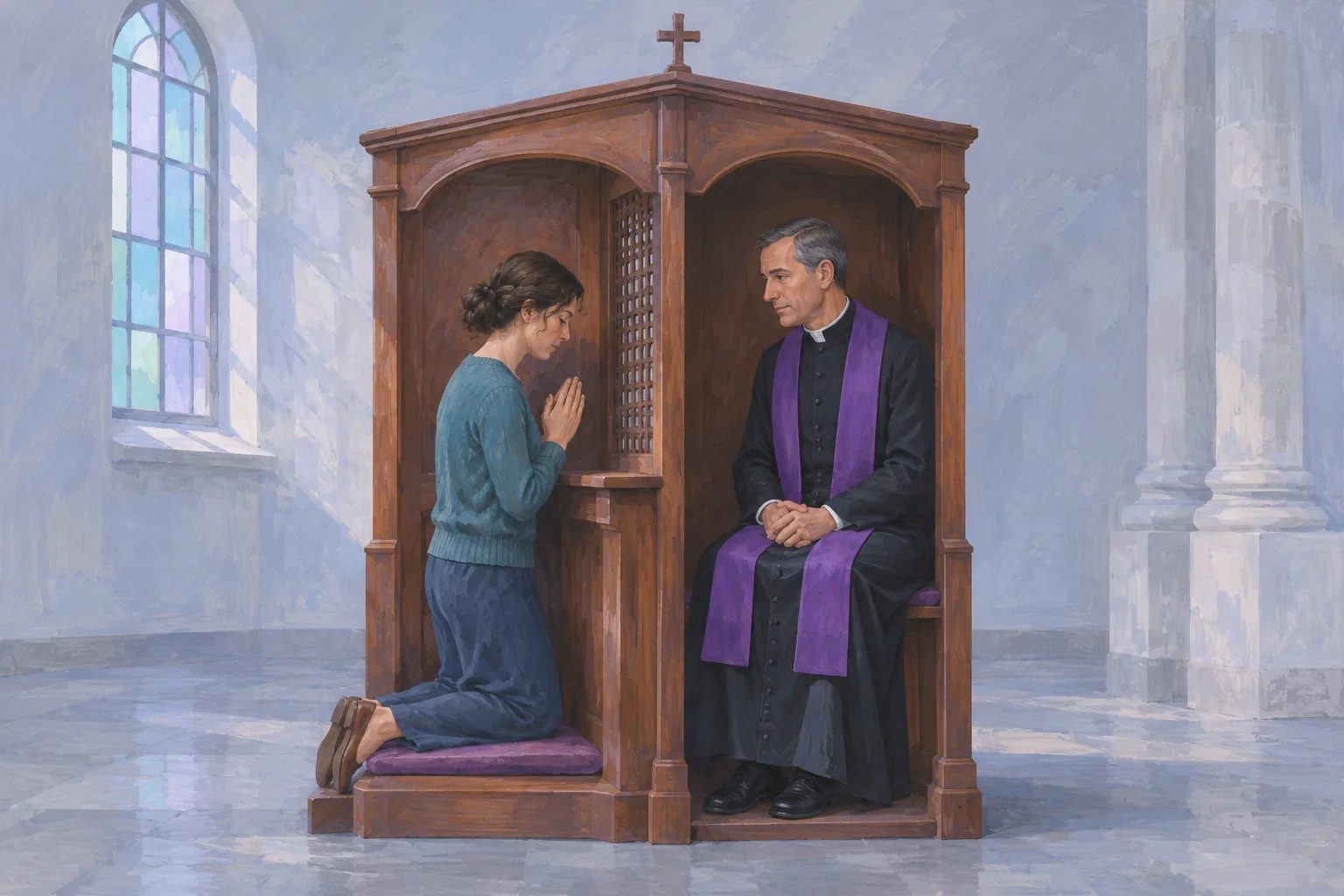
Meaning in brief
In this prayer we confess before God and one another that we have sinned in our thoughts and in our words, in what we have done and in what we have failed to do. We then ask for the prayers of the Blessed Virgin Mary, the Angels, the Saints and our brothers and sisters in faith, with the heart of the tax collector who said, "O God, be merciful to me a sinner" (Lk 18:13).
Intentions and hope
The faithful pray it to acknowledge their sins with humility and to ask for God's mercy before celebrating the Eucharist. It helps us prepare our hearts and reminds us that we do not walk alone but are supported by the prayer of the Church.
When and how to pray
- At Mass, the whole congregation prays this together during the Introductory Rites, after the greeting and a brief silence for examining our conscience.
- At the words "through my fault, through my fault, through my most grievous fault", the faithful strike their breast as a sign of sorrow.
- Afterward the priest prays for the forgiveness of the people; answer "Amen."
- Outside Mass, you can pray it on your own to examine your conscience, for example at night.
- Remember that the Penitential Act at Mass does not replace the Sacrament of Penance; grave sins must still be confessed before receiving Communion.
Where it comes from
History
The wording of the Confiteor grew out of the rite of the Sacrament of Penance. The Rule for Canons of Chrodegang of Metz (died 743) contains questions to the penitent that include wording similar to this prayer. Egbert of York (died 766) gives a short formula that the Catholic Encyclopedia calls the seed of the present prayer: "through my fault I have sinned exceedingly in thought, word and deed." [4][3]
The earliest Roman sacramentaries and ordines begin Mass with the Introit and do not mention a confession of sins before the altar. The priest probably said a confession of this kind privately in the sacristy. Evidence that this preparation took place at the altar appears only in the tenth to eleventh centuries. [3]
Bernold of Constance (died 1100) is the first writer to quote this prayer as part of the opening of Mass. His version begins "Confiteor Deo omnipotenti, istis Sanctis et omnibus Sanctis et tibi frater…" and names sins of thought, word and deed, as well as "pollution of mind and body." [3]
In the Middle Ages, the Saints named and the list of sins varied greatly from one missal to another, and many used shorter forms. A council at Ravenna in the fourteenth century is reported to have fixed the wording of this prayer word for word for its ecclesiastical province. [4][3]
After the liturgical reform, this prayer became one of the forms of the Penitential Act at Mass. The General Instruction of the Roman Missal (no. 51) describes this act as a formula of general confession concluded by the priest's absolution, which lacks the efficacy of the Sacrament of Penance. [5]
Sources & version
Text: USCCB / ICEL, The Order of Mass, USCCB text for the Roman Missal, Third Edition. Checked word for word against the source on 2026-11-05.
- The Order of Mass, USCCB text for the Roman Missal, Third Edition — The Order of Mass (USCCB)
Text follows The Order of Mass, USCCB text for the Roman Missal, Third Edition; taken from www.archbalt.org
Prayer text © USCCB / ICEL; quoted with attribution and a link (owner decision K2, ADR 0067).
- Confiteor in Latin
Latin text from catholic-repository.org
Latin text quoted with attribution and a link.
- Confiteor (Catholic Encyclopedia, 1907–1912)
Published by Catholic Answers (reprint of the Catholic Encyclopedia)
Cited as a factual source; the source text remains its publisher's.
- Catholic Encyclopedia: Confiteor
Published by New Advent
Cited as a factual source; the source text remains its publisher's.
- General Instruction of the Roman Missal
Published by Vatican.va (Congregation for Divine Worship)
Cited as a factual source; the source text remains its publisher's.
Free to copy and share. Please credit lightofsaints.com. Copyright