Lord, I Am Not Worthy
Traditional prayer of the Church; text: Order of Mass, Roman Missal, third edition (English translation, 2011). · ICEL
Bless someone else by sharing this prayer.
Free to copy and share. Please credit lightofsaints.com.
Lord, I Am Not Worthy
Lord, I am not worthy that you should enter under my roof, but only say the word and my soul shall be healed.
Latin text
Domine, non sum dignus
Domine, non sum dignus ut intres sub tectum meum, sed tantum dic verbo, et sanabitur anima mea
Meaning in brief
With the words of the centurion at Capernaum (Mt 8:8), we admit that we are not worthy to receive the Lord, yet we trust that if he will only say the word, it is enough to heal us. This prayer joins humility with trust in the mercy of Jesus.
Intentions and hope
The faithful pray it to prepare their hearts before Communion, when they feel unworthy, or when making a spiritual communion. We may hope that the Lord will heal and strengthen our soul according to his will, just as he responded to the centurion's faith.
When and how to pray
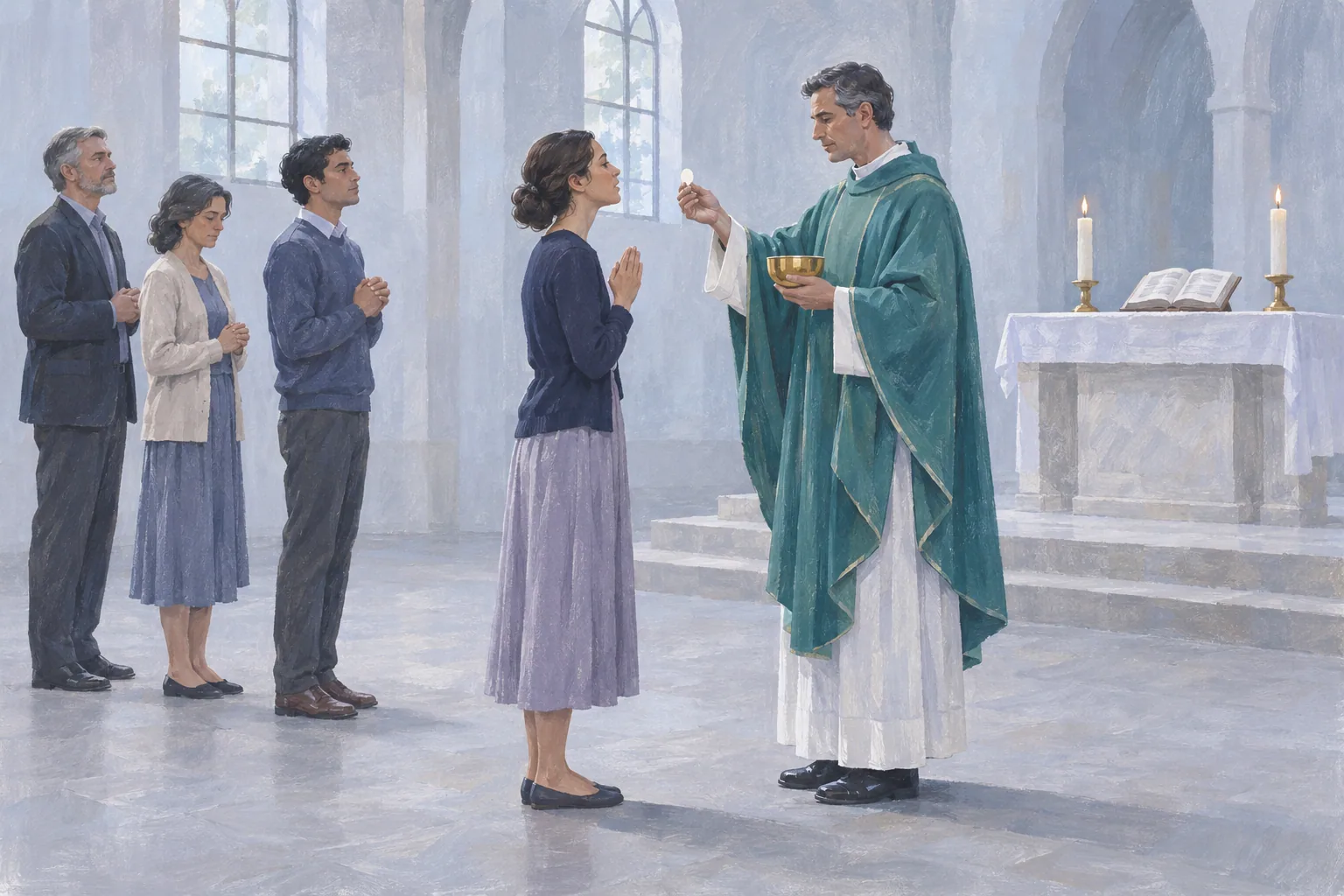
- At Mass, say it together with the congregation after the priest shows the Host and says, "Behold the Lamb of God…".
- Say it calmly while looking at the Host, then come forward to receive Communion with reverence.
- In the older form of the Mass, the priest says it three times, striking his breast each time.
- Outside Mass, pray it silently as a short prayer of trust, for example when making a spiritual communion or when you feel unworthy.
Where it comes from
History
The words of this prayer come from the Gospel account of the centurion at Capernaum who asked Jesus to heal his servant (Mt 8:8; Lk 7:6-7). The centurion, who was not a Jew, said that he was not worthy to have Jesus enter under his roof and asked Jesus only to say the word. Jesus praised his faith. [6][4]
The Catholic Encyclopedia records that before giving Communion, both during Mass and outside Mass, the priest shows the particle of the Host with the words "Ecce Agnus Dei…" and then says "Domine, non sum dignus". In this way the prayer is closely tied to the invitation to receive Communion. [5]
This prayer was not used everywhere in the same way. The Sarum Rite in medieval England did not use "Domine, non sum dignus" at Communion, but a wording of its own. [3]
Before the reform that followed the Second Vatican Council, this prayer was said three times in Latin and was a prayer of the priest alone. In the Missal of Paul VI, the people say it together aloud. [3][4]
Sources & version
Text: ICEL, Order of Mass, Roman Missal, third edition (English translation, 2011). Checked word for word against the source on 2026-11-05.
- Order of Mass, Roman Missal, third edition (English translation, 2011) — The Order of Mass
Text follows Order of Mass, Roman Missal, third edition (English translation, 2011); taken from charlestondiocese.org
Prayer text © ICEL; quoted with attribution and a link (owner decision K2, ADR 0067).
- VI. The Paschal Banquet - Catechism
Latin text from www.vatican.va
Latin text quoted with attribution and a link.
- Prayer of Humble Access
Published by Wikipedia
Cited as a factual source; the source text remains its publisher's.
- 'Domine, non sum dignus'
Published by Thinking Faith (Jesuits in Britain)
Cited as a factual source; the source text remains its publisher's.
- Agnus Dei (in Liturgy)
Published by Catholic Encyclopedia, hosted by Catholic Answers
Cited as a factual source; the source text remains its publisher's.
- Matthew 8:5-17 NRSVue
Published by Sacred Space (Irish Jesuits)
Cited as a factual source; the source text remains its publisher's.
Free to copy and share. Please credit lightofsaints.com. Copyright