Adoro Te Devote (Godhead Here in Hiding)
Traditional prayer of the Church. · Public domain
Bless someone else by sharing this prayer.
Free to copy and share. Please credit lightofsaints.com.
Adoro Te Devote
Godhead here in hiding, whom I do adore,
Masked by these bare shadows, shape and nothing more,
See, Lord, at Thy service low lies here a heart
Lost, all lost in wonder at the God thou art.
Seeing, touching, tasting are in thee deceived:
How says trusty hearing? that shall be believed;
What God’s Son has told me, take for truth I do;
Truth Himself speaks truly or there’s nothing true.
On the cross Thy godhead made no sign to men,
Here Thy very manhood steals from human ken:
Both are my confession, both are my belief,
And I pray the prayer of the dying thief.
I am not like Thomas, wounds I cannot see,
But can plainly call thee Lord and God as he;
Let me to a deeper faith daily nearer move,
Daily make me harder hope and dearer love.
O thou our reminder of Christ crucified,
Living Bread, the life of us for whom he died,
Lend this life to me then: feed and feast my mind,
There be thou the sweetness man was meant to find.
Bring the tender tale true of the Pelican;
Bathe me, Jesu Lord, in what Thy bosom ran
Blood whereof a single drop has power to win
All the world forgiveness of its world of sin.
Jesu, whom I look at shrouded here below,
I beseech thee send me what I thirst for so,
Some day to gaze on thee face to face in light
And be blest for ever with Thy glory’s sight. Amen.
Latin text
Adoro te devote
Adoro te devote, latens Deitas,
Quae sub his figuris vere latitas:
Tibi se cor meum totum subjicit,
Quia te contemplans totum deficit.
Visus, tactus, gustus in te fallitur,
Sed auditu solo tuto creditur;
Credo quidquid dixit Dei Filius:
Nil hoc verbo Veritatis verius.
In cruce latebat sola Deitas,
At hic latet simul et humanitas;
Ambo tamen credens atque confitens,
Peto quod petivit latro poenitens.
Plagas, sicut Thomas, non intueor;
Deum tamen meum te confiteor;
Fac me tibi semper magis credere,
In te spem habere, te diligere.
O memoriale mortis Domini!
Panis vivus, vitam praestans homini!
Praesta meae menti de te vivere
Et te illi semper dulce sapere.
Pie pellicane, Jesu Domine,
Me immundum munda tuo sanguine;
Cujus una stilla salvum facere
Totum mundum quit ab omni scelere.
Jesu, quem velatum nunc aspicio,
Oro fiat illud quod tam sitio;
Ut te revelata cernens facie,
Visu sim beatus tuae gloriae. Amen
Meaning in brief
This prayer confesses that Jesus is truly present under the appearance of bread, even though sight, touch and taste do not perceive him; faith rests on the word that is heard (cf. Rom 10:17). Like Thomas, who cried out "My Lord and my God" (Jn 20:28), the one praying asks for an increase of faith, hope and love, and to be cleansed by the blood of Christ.
Intentions and hope
The faithful pray it to give thanks after receiving Communion and to deepen their faith in the presence of Jesus in the Eucharist. One may hope that one's heart draws closer to Christ and that one's faith grows, without demanding any particular result.
When and how to pray
- Pray it after receiving Holy Communion, during a quiet moment in the pew, as an act of thanksgiving.
- Pray it also during adoration before the Blessed Sacrament or before Benediction of the Blessed Sacrament.
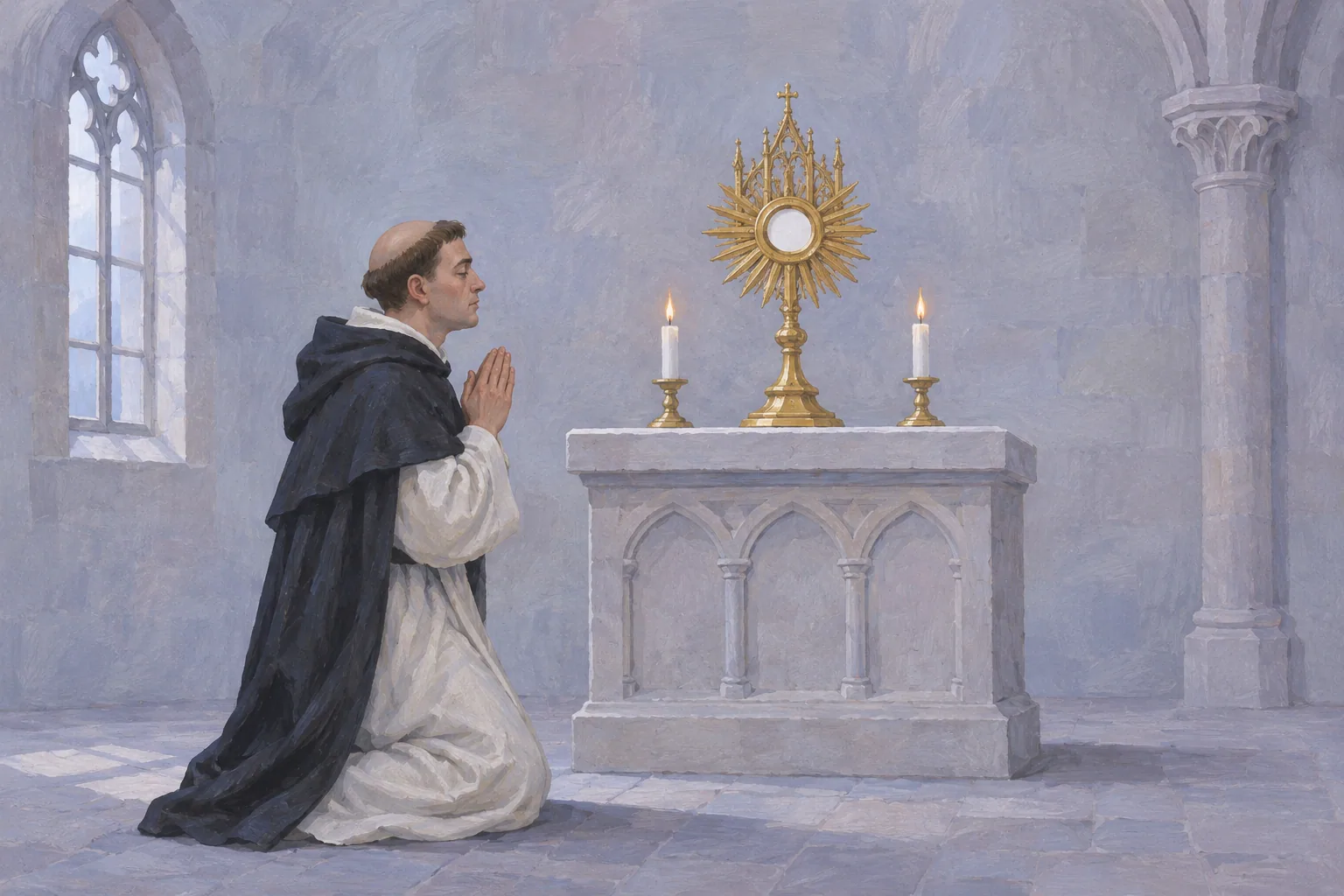
- Kneel or sit quietly, and turn your gaze toward the tabernacle or the monstrance.
- Recite or sing it slowly, verse by verse, pausing briefly at any words that touch your heart.
- This prayer is also fitting around the Solemnity of the Most Holy Body and Blood of Christ.
Where it comes from
History
Tradition · According to tradition, this rhymed hymn was composed by Saint Thomas Aquinas (c. 1225–1274). The prayer is addressed to Christ present in the Blessed Sacrament. [3][4]
The oldest known manuscripts date from about fifty years after Thomas's death, and no source from that period names him as the author. In the twentieth century, Dom André Wilmart judged that the documentary evidence was not enough to establish Thomas's authorship. Grabmann, on the other hand, defended it, because all the manuscripts give Thomas's name and the content of the poem reflects his theology of the Eucharist. Raby noted that a poem by Jacopone da Todi (c. 1280–1294) seems already to presuppose the Adoro te. [3][4]
More recent scholarship tends to favor Thomas. The final version of Tocco's biography of Thomas (completed in 1323) contains the text and names Thomas as its author. Wielockx (1998) found that 44 of 51 sources name Thomas, and Schoot calls Thomas almost certainly its author. [5]
At first the text was not part of the official liturgy. Pope Saint Pius V included it among the prayers of thanksgiving after Communion in the Roman Missal of 1570. The Latin text circulates in two forms: Wilmart's critical edition and the popular text that has been sung for centuries and is the most widely used, with differences such as "latens deitas" and "latens veritas". [4]
In the Enchiridion Indulgentiarum (1968), this prayer is listed under the title "Hidden God (Adoro te devote)" and is granted a partial indulgence. [6]
Sources & version
Text: Public domain. Checked word for word against the source on 2026-11-05.
- Week 33 | On the Road to Emmaus | Pray w/ Aquinas' "Adoro Te Devote" (Hopkins' translation)
Text taken from www.dioceseoflansing.org
Prayer text in the public domain.
- Adoro Te Devote - Indonesian Papist
Latin text from www.indonesianpapist.com
Latin text quoted with attribution and a link.
- Adoro Te Devote
Published by Encyclopedia.com (New Catholic Encyclopedia)
Cited as a factual source; the source text remains its publisher's.
- The Adoro Te Devote (liturgy Q&A, Zenit, 25 May 2010)
Published by EWTN Library / Zenit
Cited as a factual source; the source text remains its publisher's.
- The Adoro Te Devote of St. Thomas Aquinas
Published by Project MUSE (scholarly article)
Cited as a factual source; the source text remains its publisher's.
- Works and Prayers Listed in 'Enchiridion of Indulgences'
Published by CatholicCulture.org (digest, not an exact reprint)
Cited as a factual source; the source text remains its publisher's.
- Saint Thomas Aquinas, Confessor, Doctor of the Church
Published by EWTN Library (Butler's Lives of the Saints)
Cited as a factual source; the source text remains its publisher's.
Free to copy and share. Please credit lightofsaints.com. Copyright