Hail, True Body (Ave Verum Corpus)
Traditional prayer of the Church. · The rights holder named on the source
Bless someone else by sharing this prayer.
Free to copy and share. Please credit lightofsaints.com.
Hail, True Body
Hail the true body, born of the Virgin Mary: You who truly suffered and were sacrificed on the cross for the sake of man.
From whose pierced side flowed water and blood: Be a foretaste for us in the trial of death.
O sweet, O gentle, O Jesu, son of Mary, have mercy on me.
Amen.
Latin text
Ave verum corpus
Ave, verum corpus natum
de Maria Virgine:
vere passum, immolatum
in cruce pro homine:
cuius latus perforatum
fluxit aqua et sanguine:
esto nobis praegustatum,
in mortis examine.
O Jesu dulcis, O Jesu pie,
O Jesu Fili Mariae.
Miserere mei. Amen.
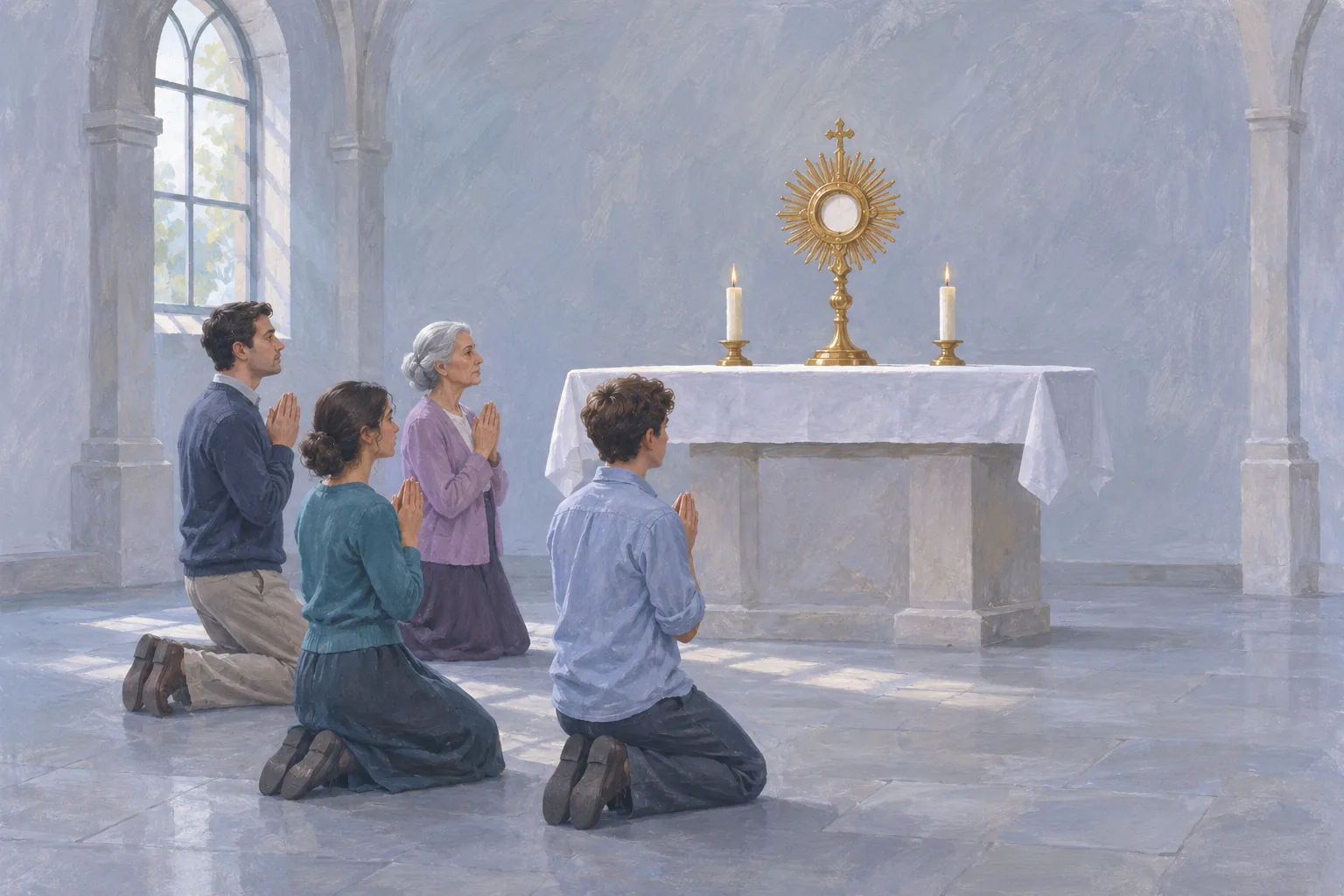
Meaning in brief
This prayer greets the Body of Christ, born of the Virgin Mary, who truly suffered and was sacrificed on the cross, from whose side, pierced by a spear, flowed water and blood (cf. John 19:34). It asks that his Body be a foretaste for us in the trial of death.
Intentions and hope
The faithful pray it to adore Jesus in the Eucharist, to give thanks after Communion, and to ask for strength of faith when facing illness and death. What one may hope for is a heart drawn ever closer to Christ and peace in entrusting one's life to him.
When and how to pray
- Pray or sing it before the Most Blessed Sacrament, for example during adoration or Benediction of the Blessed Sacrament.
- It may also be prayed privately as a brief thanksgiving after receiving Communion.
- Kneel or sit quietly, and turn your gaze toward the tabernacle or the monstrance.
- Say it slowly; pause for a moment at the lines about the cross and the pierced side.
- This prayer is especially fitting on the Solemnity of the Most Holy Body and Blood of Christ and on Holy Thursday.
Where it comes from
History
Ave verum corpus is a short Latin Eucharistic hymn from the Middle Ages. It was sung at the elevation, the moment when the Host is lifted up during Mass. This part of the Mass was itself introduced only in the 12th century. [3][4]
The oldest known witness to the text is a 13th-century Franciscan manuscript from central Italy (Chicago, Newberry Library, 24). The text also appears in other manuscripts, among them a Bodleian Library manuscript from around 1340, but it is not found often in medieval manuscripts. [3][5]
The author is unknown. The claim that the hymn was composed by Pope Innocent VI (reigned 1352–1362) is judged unlikely or untenable, since the text already existed in manuscripts of the 13th or early 14th century, before his pontificate. The New Catholic Encyclopedia suggests that the hymn probably comes from northern Italy. [3][4]
The hymn grew out of late medieval Eucharistic devotion centered on the moment of the elevation; that period produced many short prayers of this kind. A related hymn, Ave Christi Corpus verum, was used when the chalice was lifted up. The New Catholic Encyclopedia also notes that its closing lines reverse the roles of Christ and Mary, as in the Hail, Holy Queen. [4]
Today the hymn is no longer a fixed part of the Mass. It lives on as a chant, often sung at Benediction of the Blessed Sacrament or as a Communion antiphon. [4]
Sources & version
Text: The rights holder named on the source. Checked word for word against the source on 2026-11-05.
- William Byrd, Ave verum corpus
Text taken from canticasacra.org
Prayer text © The rights holder named on the source; quoted with attribution and a link (owner decision K2, ADR 0067).
- Ave verum corpus natum - Dictionary of Hymnology
Published by Hymnology Archive (Hymns Ancient & Modern)
Cited as a factual source; the source text remains its publisher's.
- Ave Verum Corpus
Published by New Catholic Encyclopedia (via Encyclopedia.com)
Cited as a factual source; the source text remains its publisher's.
- Ave verum corpus
Published by Wikipedia
Cited as a factual source; the source text remains its publisher's.
Free to copy and share. Please credit lightofsaints.com. Copyright