Tantum Ergo
Traditional prayer of the Church. · Public domain
Bless someone else by sharing this prayer.
Free to copy and share. Please credit lightofsaints.com.
Tantum Ergo Sacramentum
Down in adoration falling,
Lo! the sacred Host we hail;
Lo! o'er ancient forms departing,
newer rites of grace prevail;
faith for all defects supplying,
where the feeble senses fail.
To the everlasting Father,
and the Son who reigns on high,
with the Holy Ghost proceeding
forth from Each eternally,
be salvation, honor, blessing,
might and endless majesty. Amen.
Latin text
Tantum Ergo
Tantum ergo Sacraméntum,
Venerémur cérnui:
Et antíquum documentum
Novo cedat rítui;
Præstet fides suppleméntum
Sénsuum deféctui.
Genitori Genitóque,
Laus et iubilátio;
Salus, honor, virtus quoque,
Sit et benedíctio;
Procedénti ab utróque
Compar sit laudátio.
Amen.
Meaning in brief
This hymn invites us to give glory to the Blessed Sacrament, in which the order of the new covenant takes the place of the old, and to acknowledge that faith upholds what the senses cannot grasp (cf. 2 Cor 5:7). The hymn closes with praise to the Father, the Son, and the Holy Spirit.
Intentions and hope
The faithful sing or pray it to adore Jesus Christ present in the Eucharist, to give thanks for that gift, and to ask for a firmer faith. One may hope for a heart that grows calmer and closer to God before the Blessed Sacrament.
When and how to pray
- It is usually sung together at Benediction of the Blessed Sacrament, which often closes adoration, a holy hour, the Stations of the Cross, or a Eucharistic procession.
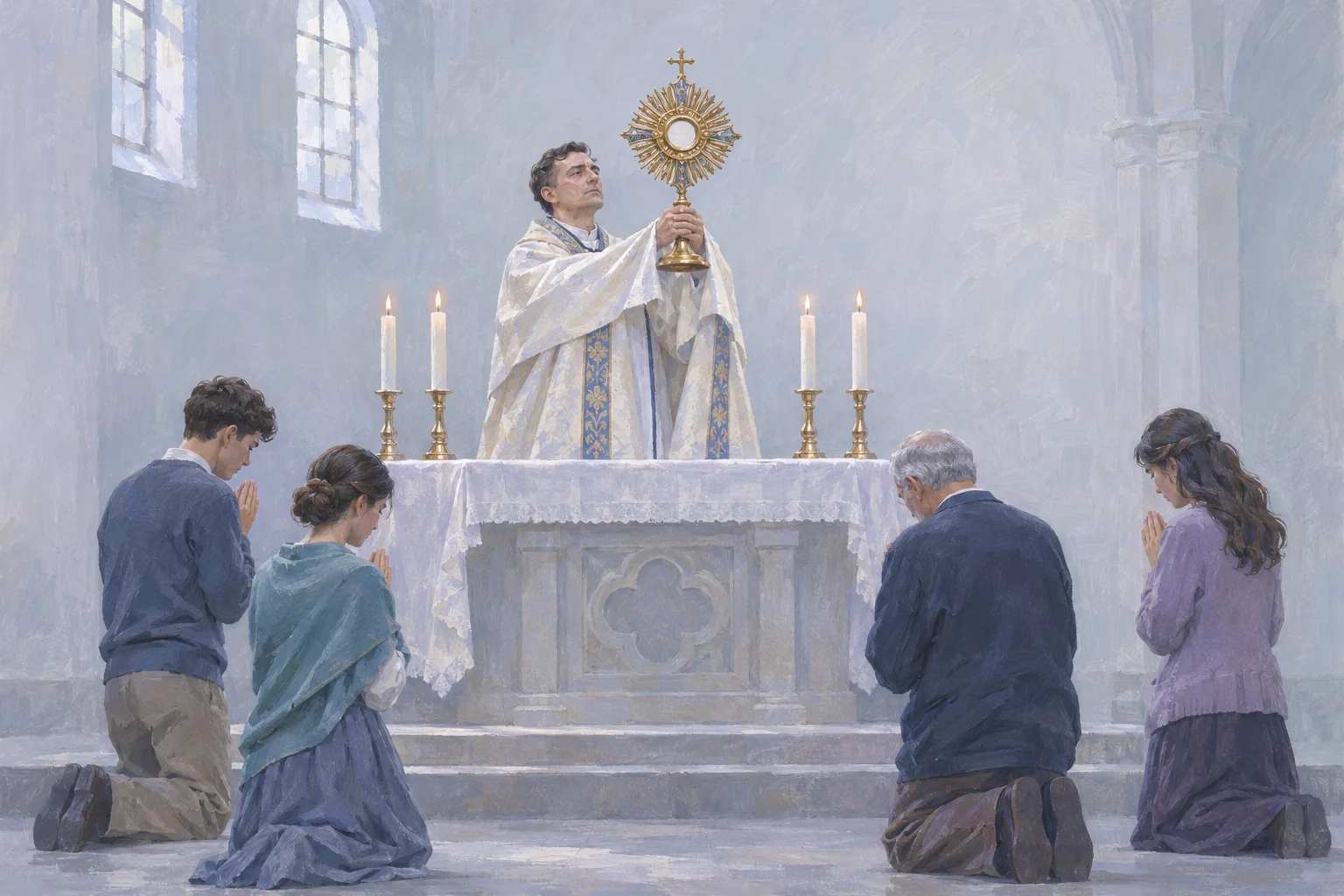
- Kneel facing the Blessed Sacrament exposed in the monstrance while the hymn is sung.
- The hymn is also sung at the procession on the Solemnity of the Most Holy Body and Blood of Christ and on Holy Thursday, when the Blessed Sacrament is carried to the place of repose after the Mass of the Lord's Supper.
- After the hymn, the priest says a versicle and a closing prayer; during Easter Time, 'Alleluia' is added.
- In private, this hymn may be prayed quietly before the tabernacle.
Where it comes from
History
According to the historical record, Pope Urban IV asked the Dominican theologian Saint Thomas Aquinas to compose the texts of the Mass and the Liturgy of the Hours for the newly established Solemnity of Corpus Christi. The hymn Pange lingua, which contains the Tantum ergo, is attributed to Aquinas as part of that work. [3]
Scholarly study places the writing of Aquinas's hymns for the Solemnity of Corpus Christi around 1261–1265. Many popular sources give the year 1264, but the exact year of composition is not known. [4]
Tantum ergo Sacramentum is not really a hymn of its own. These verses are the last two stanzas of the hymn Pange lingua gloriosi Corporis mysterium, sung at Evening Prayer (Vespers) on the Solemnity of Corpus Christi; over time those two stanzas came to be sung on their own. [3][4]
Tradition · Traditionally the Tantum ergo is sung at Benediction of the Blessed Sacrament, and many melodies have been arranged or composed for it. The versicle and prayer that follow this hymn at Benediction of the Blessed Sacrament were added at a later time. [3]
Sources & version
Text: Public domain. Checked word for word against the source on 2026-11-05.
- Tantum Ergo Sacramentum - Ascension Press
Text taken from ascensionpress.com
Prayer text in the public domain.
- Tantum Ergo: A Catholic Reference Overview
Latin text from www.ewtn.com
Latin text quoted with attribution and a link.
- Hymns for Corpus Christi (Introduction)
Published by Liturgy Office of the Bishops' Conference of England and Wales
Cited as a factual source; the source text remains its publisher's.
- Praise, O Sion, Your Savior: Eucharistic Presence in St. Thomas Aquinas' Summa and Hymns
Published by University of Dayton thesis (OhioLINK)
Cited as a factual source; the source text remains its publisher's.
Free to copy and share. Please credit lightofsaints.com. Copyright