Soul of Christ (Anima Christi)
Traditional prayer of the Church. · USCCB
Bless someone else by sharing this prayer.
Free to copy and share. Please credit lightofsaints.com.
Anima Christi
Soul of Christ, sanctify me.
Body of Christ, save me.
Blood of Christ, embolden me.
Water from the side of Christ, wash me.
Passion of Christ, strengthen me.
O good Jesus, hear me.
Within your wounds hide me.
Never permit me to be parted from you.
From the evil Enemy defend me.
At the hour of my death call me
and bid me come to you,
that with your Saints I may praise you
for age upon age.
Amen.
Latin text
Anima Christi
Anima Christi, sanctifica me.
Corpus Christi, salva me.
Sanguis Christi, inebria me.
Aqua lateris Christi, lava me.
Passio Christi, conforta me.
O Bone Iesu, exaudi me.
Intra tua vulnera absconde me.
Ne permittas me separari a te.
Ab hoste maligno defende me.
In hora mortis meae voca me.
Et iube me venire ad te,
ut cum Sanctis tuis laudem te
in saecula saeculorum. Amen.
Meaning in brief
This prayer addresses Jesus through his Soul, Body, Blood, the water from his side, and his Passion, and asks that we be sanctified, washed and strengthened. We also ask never to be parted from him and to praise him with his Saints (cf. Jn 19:34).
Intentions and hope
The faithful pray it as a thanksgiving after Communion, and also to ask for strength in temptation and protection at the hour of death. What we may hope for is an ever closer union with Christ, not any particular result.
When and how to pray
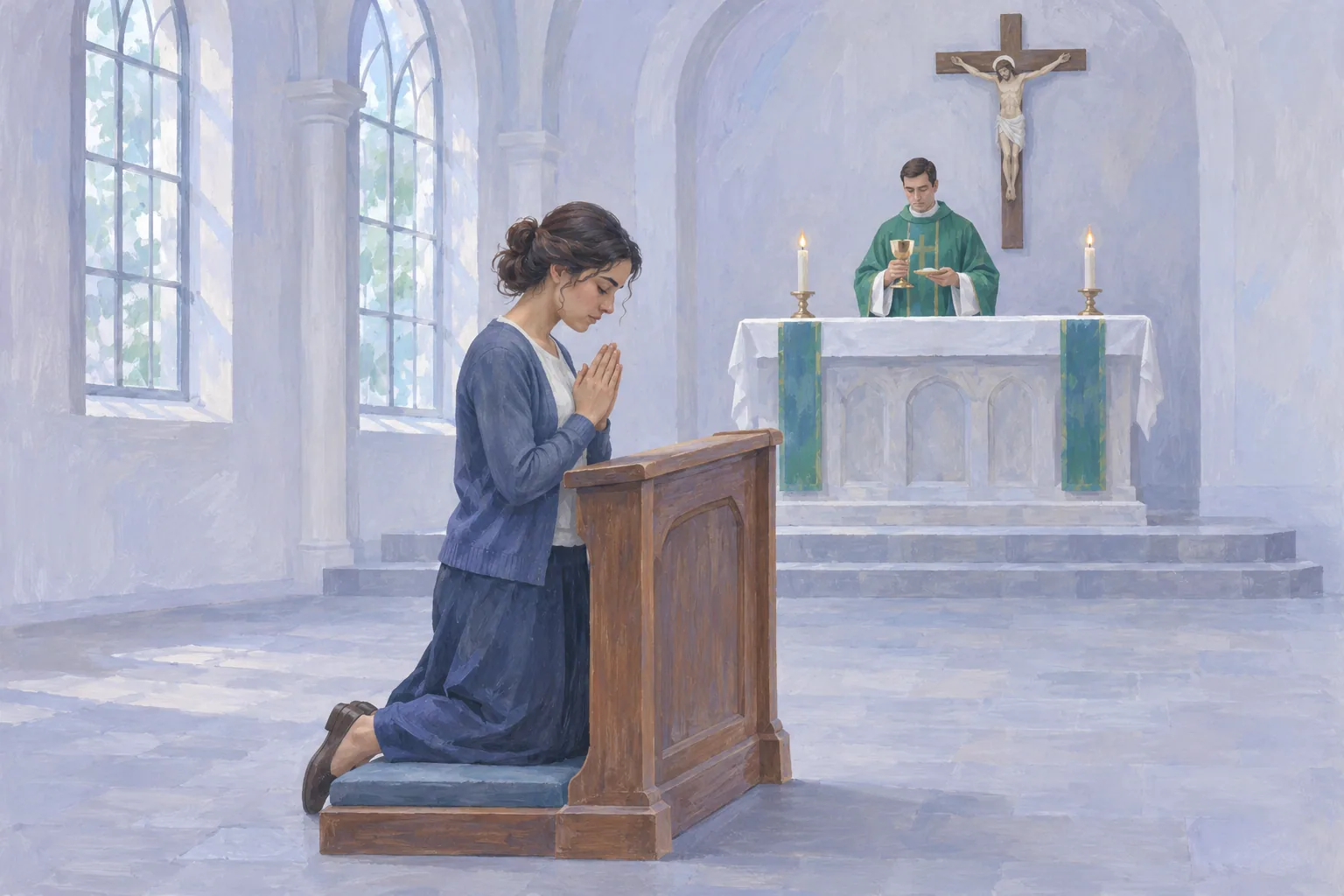
- Pray it after receiving Holy Communion, in a quiet moment in the pew, kneeling or sitting.
- Say it slowly, one invocation at a time, pausing to reflect on each.
- You can also pray it after Mass, in the morning, or as a spiritual communion when you cannot receive.
- It is also well suited to adoration of the Blessed Sacrament and to reflection on the Passion of Christ during Lent.
Where it comes from
History
The Soul of Christ (Anima Christi) dates from the first half of the 14th century, and its author is unknown. Early witnesses include an English manuscript from around 1370, a text carved in the Alcázar palace in Andalusia around 1364, and the Swabian mystic Margaret Ebner (died 1351), who already knew the prayer. [3][4]
The prayer book of Cardinal Peter of Luxembourg (died 1387), kept in a library in Avignon, contains the prayer in practically the same form used today. By the 15th century the prayer was widely known in Europe and often appeared in books of hours and other devotional books. [3][4]
Saint Ignatius of Loyola (born 1491) recommended this prayer in the Spiritual Exercises, but usually quoted only its opening words. This shows that the prayer was already familiar to the faithful in his time and was not his own composition. For this reason it is also known as the "Aspiration of Saint Ignatius". [3][4]
Tradition · The prayer is linked to Pope John XXII because of the indulgence attached to it. The Catholic Encyclopedia gives the year 1330, while an English manuscript from around 1370 records an indulgence of 3,000 days from him. Whether he composed the prayer remains uncertain, since he may only have granted the indulgence. [3][4]
The current Enchiridion Indulgentiarum (Manual of Indulgences) grants a partial indulgence to the faithful who make a thanksgiving after Communion using a devout prayer approved by the Church, and names the Soul of Christ as one example. [5][6]
Sources & version
Text: USCCB. Checked word for word against the source on 2026-11-05.
- Anima Christi
Text taken from www.usccb.org
Prayer text © USCCB; quoted with attribution and a link (owner decision K2, ADR 0067).
- Anima Christi - Magnificat USA
Latin text from us.magnificat.net
Latin text quoted with attribution and a link.
- Anima Christi (Catholic Encyclopedia, 1913 entry)
Published by Catholic Answers (reprint of the Catholic Encyclopedia)
Cited as a factual source; the source text remains its publisher's.
- Anima Christi (New Catholic Encyclopedia)
Published by Encyclopedia.com / New Catholic Encyclopedia
Cited as a factual source; the source text remains its publisher's.
- 8. Indulgences for Eucharistic and Spiritual Communion (extract from the Manual of Indulgences)
Published by SC Ecclesia (extract of the Manual of Indulgences; not the Vatican site)
Cited as a factual source; the source text remains its publisher's.
- Works and Prayers Listed in 'Enchiridion of Indulgences'
Published by CatholicCulture.org
Cited as a factual source; the source text remains its publisher's.
Free to copy and share. Please credit lightofsaints.com. Copyright