The Nicene Creed
Traditional prayer of the Church. · The rights holder named on the source
Bless someone else by sharing this prayer.
Free to copy and share. Please credit lightofsaints.com.
The Nicene Creed
I believe in one God,
the Father almighty,
maker of heaven and earth,
of all things visible and invisible.
I believe in one Lord Jesus Christ,
the Only Begotten Son of God,
born of the Father before all ages.
God from God, Light from Light,
true God from true God,
begotten, not made, consubstantial with the Father;
through him all things were made.
For us men and for our salvation
he came down from heaven,
and by the Holy Spirit was incarnate of the Virgin Mary,
and became man.
For our sake he was crucified under Pontius Pilate,
he suffered death and was buried,
and rose again on the third day
in accordance with the Scriptures.
He ascended into heaven
and is seated at the right hand of the Father.
He will come again in glory
to judge the living and the dead
and his kingdom will have no end.
I believe in the Holy Spirit, the Lord, the giver of life,
who proceeds from the Father and the Son,
who with the Father and the Son is adored and glorified,
who has spoken through the prophets.
I believe in one, holy, catholic and apostolic Church.
I confess one Baptism for the forgiveness of sins
and I look forward to the resurrection of the dead
and the life of the world to come.
Amen.
Latin text
Symbolum Nicaeno-Constantinopolitanum
Credo in unum Deum,
Patrem omnipoténtem,
Factorem cæli et terræ,
visibílium ómnium et invisibilium
Et in unum Dóminum Iesum
Christum,
Filium Dei unigénitum
et ex Patre natum
ante ómnia sǽcula:
Deum de Deo, Lumen de Lúmine,
Deum verum de Deo vero,
génitum, non factum, consubstantiálem Patri: per quem ómnia
facta sunt;
qui propter nos hómines
et propter nostram salútem,
descéndit de cælis, et incarnátus est
de Spíritu Sancto ex Maria Víirgine
et homo factus est, crucifíxus étiam
pro nobis sub Póntio Piláto, passus
et sepúltus est, et resurréxit tértia
die secúndum Scriptúras,
et ascéndit in cælum, sedet ad
déxteram Patris, et íterum ventúrus
est cum glória, iudicáre vivos et
mórtuos, cuius regni non erit finis.
Credo in Spíritum Sanctum, Dominum et vivificántem, qui ex Patre
Filióque procédit, qui cum Patre et
Fílio simul adorátur et conglorificátur, qui locútus est per prophétas.
Et unam sanctam cathólicam
et apostólicam Ecclésiam.
Confíteor unum Baptísma
in remissiónem peccatórum.
Et exspécto resurrectiónem mortuórum,
et vitam ventúri sæculi.
Amen.
Meaning in brief
This creed professes faith in one God: the Father, the Creator; the Son, consubstantial with the Father, who became man for our salvation; and the Holy Spirit, who with the Father and the Son is adored and glorified. It also professes the one, holy, catholic and apostolic Church, and looks forward to the resurrection of the dead and the life of the world to come.
Intentions and hope
The faithful pray it to strengthen and renew their faith, especially when faith feels shaky or when they want to be united with the whole Church. We may hope that the Holy Spirit will help us understand and live what we say.
When and how to pray
- At Mass on Sundays and solemnities, the Creed is said together after the homily and before the Universal Prayer (Prayer of the Faithful).
- The whole congregation stands as a sign of a shared profession of faith.
- At the words about Jesus, who by the Holy Spirit was incarnate of the Virgin Mary and became man, the faithful usually bow their heads or make a bow.
- Outside Mass, this creed can be prayed quietly on your own, for example in the morning, reflecting on one part each time.
Where it comes from
History
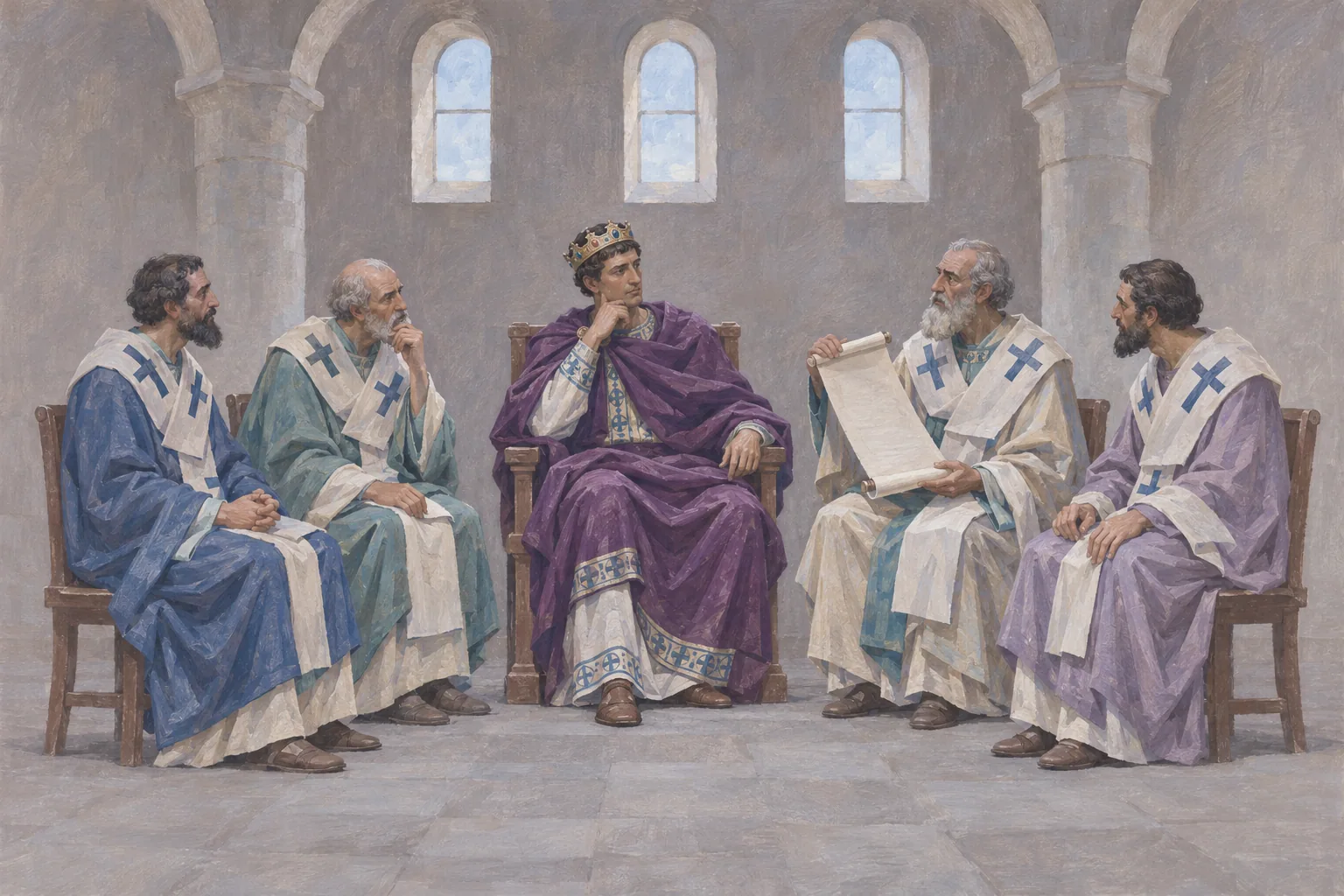
The First Council of Nicaea (325), convened by Emperor Constantine, professed that the Son is consubstantial (homoousios) with the Father, against the teaching of Arius, and produced the first form of the creed in Greek. The First Council of Constantinople (381), convened by Emperor Theodosius I with about 150 bishops, confirmed the faith of Nicaea and completed the creed, especially regarding the Holy Spirit. The Catechism (no. 195) says this creed draws its great authority from these two councils and remains common to all the great Churches of East and West. [5][4][3]
The exact wording of the creeds of 325 and 381 is first recorded in surviving documents only at the Council of Chalcedon (451). There the creed of the "150 fathers" was read together with the creed of Nicaea as a standard of faith. For this reason scholars still discuss how the text of Constantinople relates to the creed of 325; the traditional view, supported by Chalcedon itself, is that the text of 381 is in harmony with the faith of Nicaea. [6]
The Latin (Western) form differs from the Greek text of 381: "Deum de Deo" and "Filioque" ("and the Son") were added. The Filioque was inserted by the Third Council of Toledo in Spain at the end of the 6th century to counter Arianism, and its use then spread in the Frankish Church in the 8th century. The Eastern Churches objected to this insertion, while the Catechism (no. 246) acknowledges the Latin tradition that the Holy Spirit proceeds from the Father and the Son. [6][4]
This creed was not originally written for Mass but as a standard of faith. It entered the Latin liturgy through the court of Charlemagne at the end of the 8th century and spread in Frankish lands, but not yet in Rome. In 1014, at the request of King Henry II, who had come to Rome to be crowned emperor, Pope Benedict VIII for the first time had the Creed (with the Filioque) sung at Mass in Rome. Since then the Creed has been part of the Roman Mass on Sundays and solemnities. [6][7]
Tradition · According to tradition, before 1014 the Church of Rome used the creed without the Filioque. Pope Leo III (795–816) is said to have refused the insertion and reportedly had the creed in Latin and Greek, without that addition, placed on silver shields in Saint Peter's Basilica. [7]
Sources & version
Text: The rights holder named on the source. Checked word for word against the source on 2026-11-06.
- Nicene Creed
Text taken from www.usccb.org
Prayer text © The rights holder named on the source; quoted with attribution and a link (owner decision K2, ADR 0067).
- Compendium of the Catechism of the Catholic Church
Latin text from www.vatican.va
Latin text quoted with attribution and a link.
- Catechism of the Catholic Church - Paragraph # 195
Published by St. Charles Borromeo (hosting the CCC text)
Cited as a factual source; the source text remains its publisher's.
- The Catechism of the Catholic Church, numbers 185 to 278
Published by Catholic Doors (hosting the CCC text)
Cited as a factual source; the source text remains its publisher's.
- Nicene Creed
Published by EBSCO Research Starters
Cited as a factual source; the source text remains its publisher's.
- Philip Schaff: NPNF2-14. The Seven Ecumenical Councils
Published by Christian Classics Ethereal Library
Cited as a factual source; the source text remains its publisher's.
Free to copy and share. Please credit lightofsaints.com. Copyright