Saint Clare of Assisi: Daring to Choose Christ and Poverty
Saint Clare of Assisi, a young noblewoman, left a planned marriage to follow Christ and lived in poverty at San Damiano, trusting fully in Divine Providence.
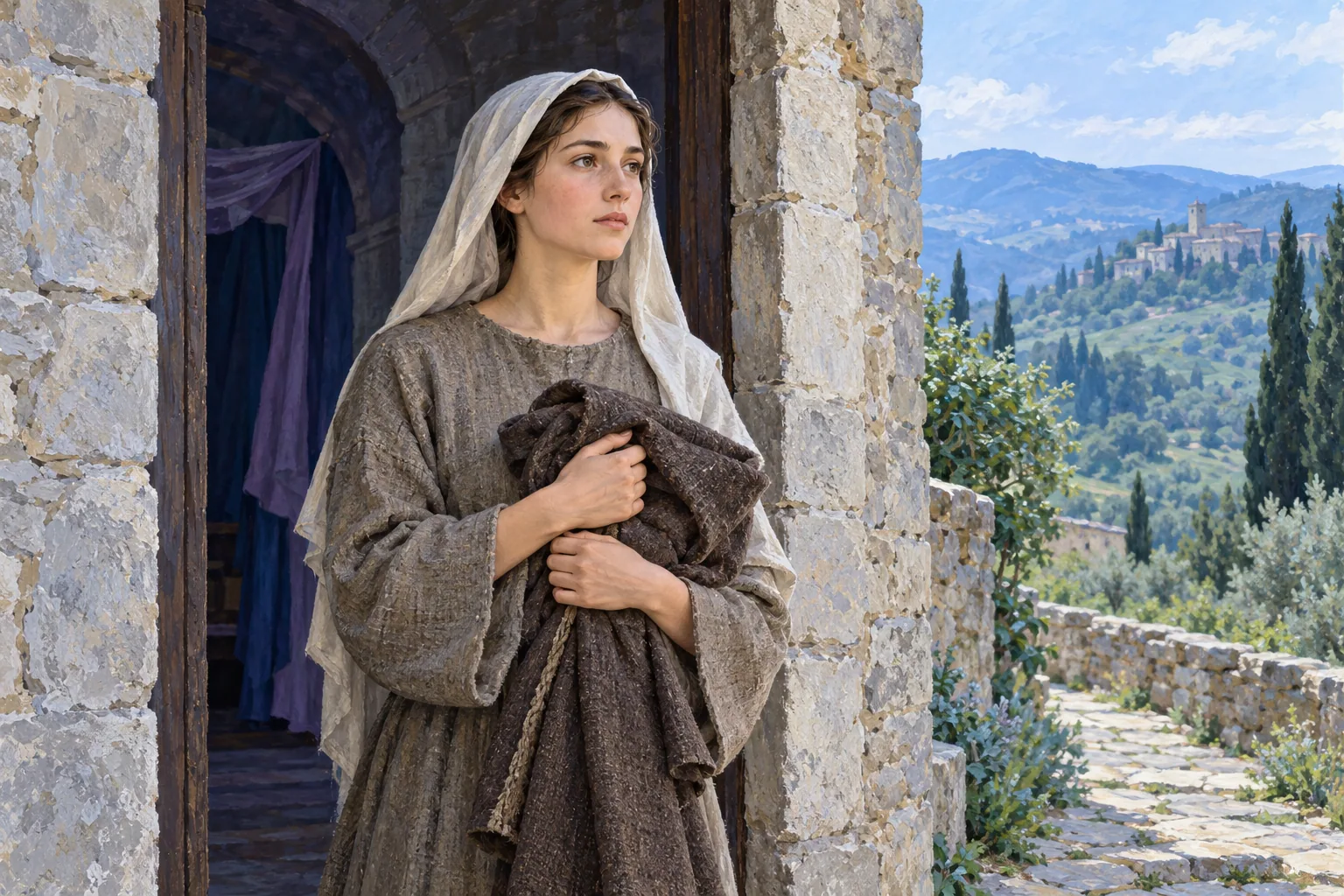
Clare was born in 1193 into a wealthy noble family. Her future seemed already settled. Her parents were planning a marriage for her with an important figure, as was the custom at the time. But Clare's heart began to be drawn in another direction.
At that time Francis, once known as the king of feasts, had changed the direction of his life for Christ. Clare, then still in her teens and endowed with a strong religious sensitivity, was moved by that witness. She looked for a way to meet Francis and let herself be caught up in his ardent love for Christ.
At the age of 18, Clare made a daring decision. Moved by a deep desire to follow Christ, she secretly left her family home with a friend. On the evening of Palm Sunday, they made their way to the Friars Minor, the followers of Francis, at the little church of the Portiuncula.
There, in the presence of his brothers, Francis cut Clare's hair. Clare put on a penitential habit of rough cloth. She gave up her noble status and her wealth and handed her whole life over to Christ in humility and poverty. In her Testament, Clare herself calls this choice a conversion.
Not all her relatives accepted that decision. Some understood it immediately; her mother, Ortolana, and two of her sisters even later followed the same life. But other relatives reacted harshly. Clare was pursued to the place Francis had prepared for her, and there were attempts, even by force, to make her go home. All these attempts failed. Clare held to her choice.
After staying for a time at other monastic communities, Clare settled with her first companions at San Damiano. The Friars Minor had arranged a small convent for them at that church. It was there that Clare would live for more than 40 years.
Day by day, the community at San Damiano grew in love of God, prayer, caring for others and service. Clare became the superior of the sisters, but she wanted to care for the sick sisters herself. She also did the most menial tasks joyfully.
Clare held to poverty radically, together with total trust in Divine Providence, that is, the conviction that God himself provided for their life. With great determination she asked for and obtained the Privilege of Poverty. Because of this, she and her sisters at San Damiano could not possess any property at all, not even in common. This request long left the Pope hesitant, but in the end he yielded to Clare's holiness.
Clare died in 1253 after decades of life at San Damiano. According to a General Audience of Pope Benedict XVI, Pope Alexander IV canonized her in 1255, only two years after her death. Since then the Church has honored her as Saint Clare of Assisi.
- Born
- 1193, into a wealthy noble family
- Left home
- At the age of 18, on the evening of Palm Sunday 1211 according to Pope Benedict XVI's audience (2010); this dating is not uniform across all sources
- Place of life
- Monastery of San Damiano, for more than 40 years until her death
- Died
- 1253
- Canonization
- 1255 by Pope Alexander IV, according to a General Audience of Pope Benedict XVI
Bring this story into your prayer.
Context & sources
General Audience 15 September 2010, para. on miracles and canonization; General Audience 15 September 2010, para. 'So who was Clare of Assisi?'; General Audience 15 September 2010, para. on birth and leaving home; General Audience 15 September 2010, para. on the events at the Portiuncula; General Audience 15 September 2010, para. on San Damiano; General Audience 15 September 2010, para. on the Privilegium Paupertatis; General Audience 15 September 2010
Official holy-see source from vatican.va, supplied in the approved brief. Official Holy See website; paraphrase and link, quotations within limits. Research snapshot; rights and final paraphrase require human review.
Year of St. Clare Letter, April 1, 2012, para. on the conversion of Francis and young Clare; Letter, April 1, 2012, para. on Clare's Testament; Letter, April 1, 2012, para. on the bishop's support; Letter, April 1, 2012, para. 'For her, as for Francis, this decision was fraught with difficulty'; Letter, April 1, 2012, same para.; Letter, April 1, 2012, para. on the meaning of Clare's conversion; Letter, April 1, 2012, para. on
Official holy-see source from vatican.va, supplied in the approved brief. Official Holy See website; paraphrase and link, quotations within limits. Research snapshot; rights and final paraphrase require human review.
Free to copy and share. Please credit lightofsaints.com. Copyright