Abraham and Isaac: When God Provides the Lamb
In Genesis 22:1-19, Abraham takes Isaac to the land of Moriah, and then God stops his hand and provides a ram to be offered in Isaac's place.
Bless someone else by sharing this story.
Free to copy and share. Please credit lightofsaints.com.
Key idea
Genesis 22:1-19 tells how God put Abraham to the test by asking him to offer Isaac, the promised son, in the land of Moriah. Abraham obeyed, but the angel of the LORD stopped him, and a ram took Isaac's place. The Church sees here the summit of Abraham's faith, trusting that God would provide, and also a prophetic sign of Christ's sacrifice.
The story opens with a call: “Some time after these events, God put Abraham to the test. He called to him, "Abraham!" "Ready!" he replied.” (Gn 22:1). Then comes a crushing command. God tells Abraham to take Isaac, his only son, whom he loves, to the land of Moriah and offer him as a burnt offering on a height that God will point out.
Abraham does not delay. Early the next morning he saddles his donkey, cuts the wood for the burnt offering, and sets out with two of his servants and Isaac. Imagine the journey: the dusty road, the donkey's steps, and a father who perhaps kept silent more than he spoke. Scripture does not tell us what was in his heart.
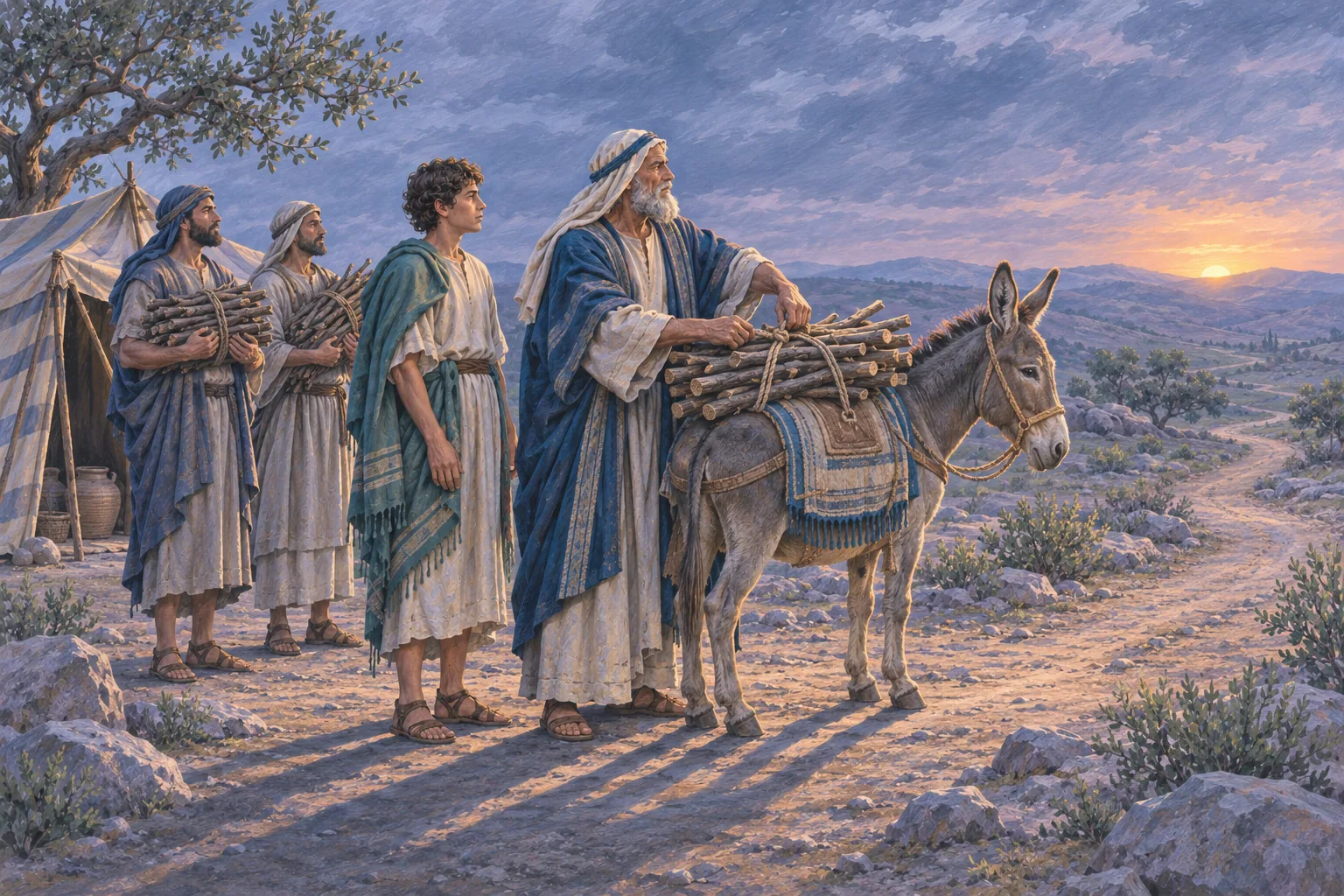
On the third day Abraham sees the place from afar. He tells the two servants to stay with the donkey, saying that he and the boy will go over there to worship and then come back. The words are simple, yet he speaks of both of them returning.
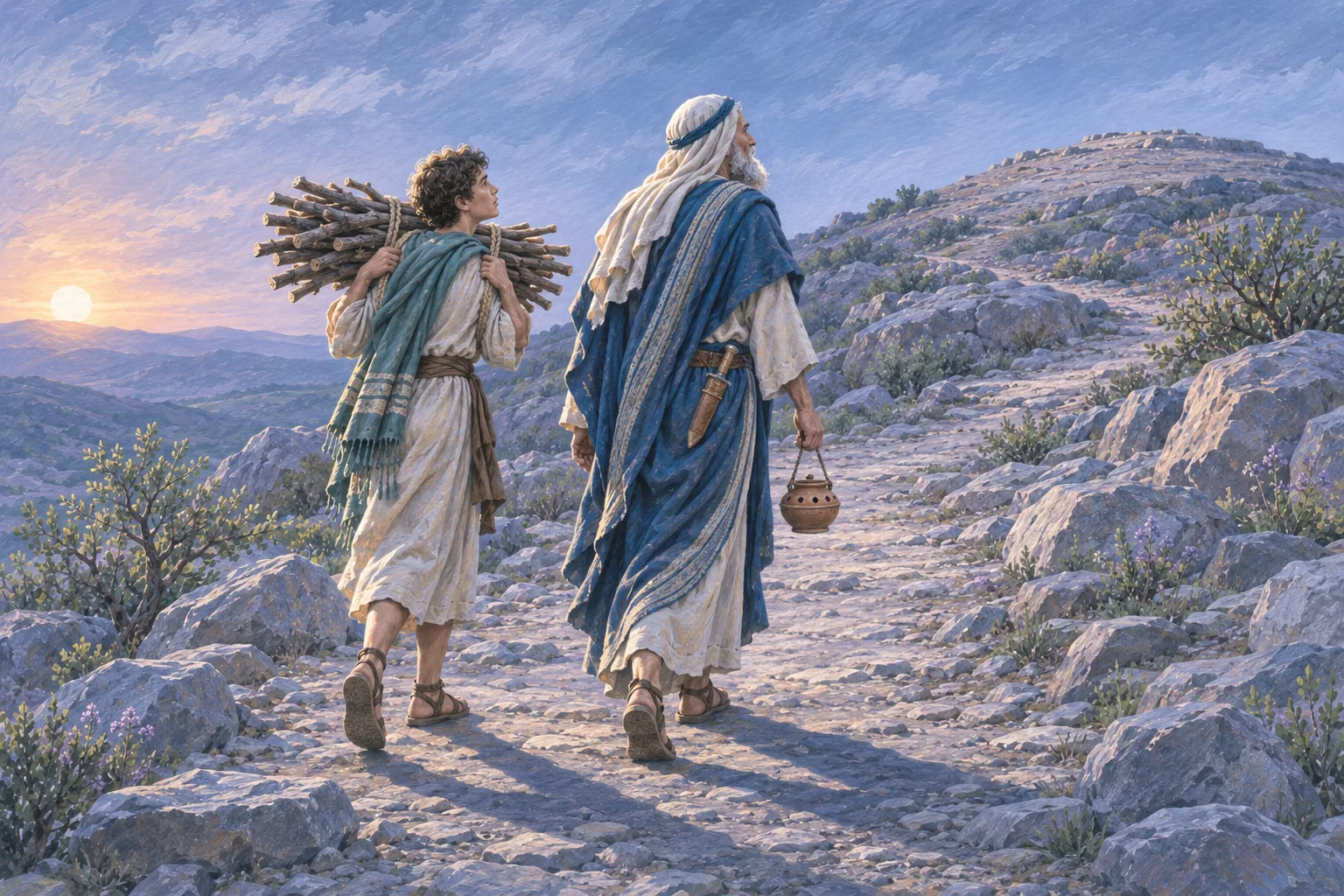
Abraham lays the wood for the burnt offering on Isaac's shoulders, while he himself carries the fire and the knife. Along the way comes a short conversation that is hard to forget: “As the two walked on together, Isaac spoke to his father Abraham. "Father!" he said. "Yes, son," he replied. Isaac continued, "Here are the fire and the wood, but where is the sheep for the holocaust?"” (Gn 22:7).
Abraham's answer is brief: “"Son," Abraham answered, "God himself will provide the sheep for the holocaust." Then the two continued going forward.” (Gn 22:8). Perhaps his voice trembled. The text records only that father and son walked on side by side toward the place God had shown him.
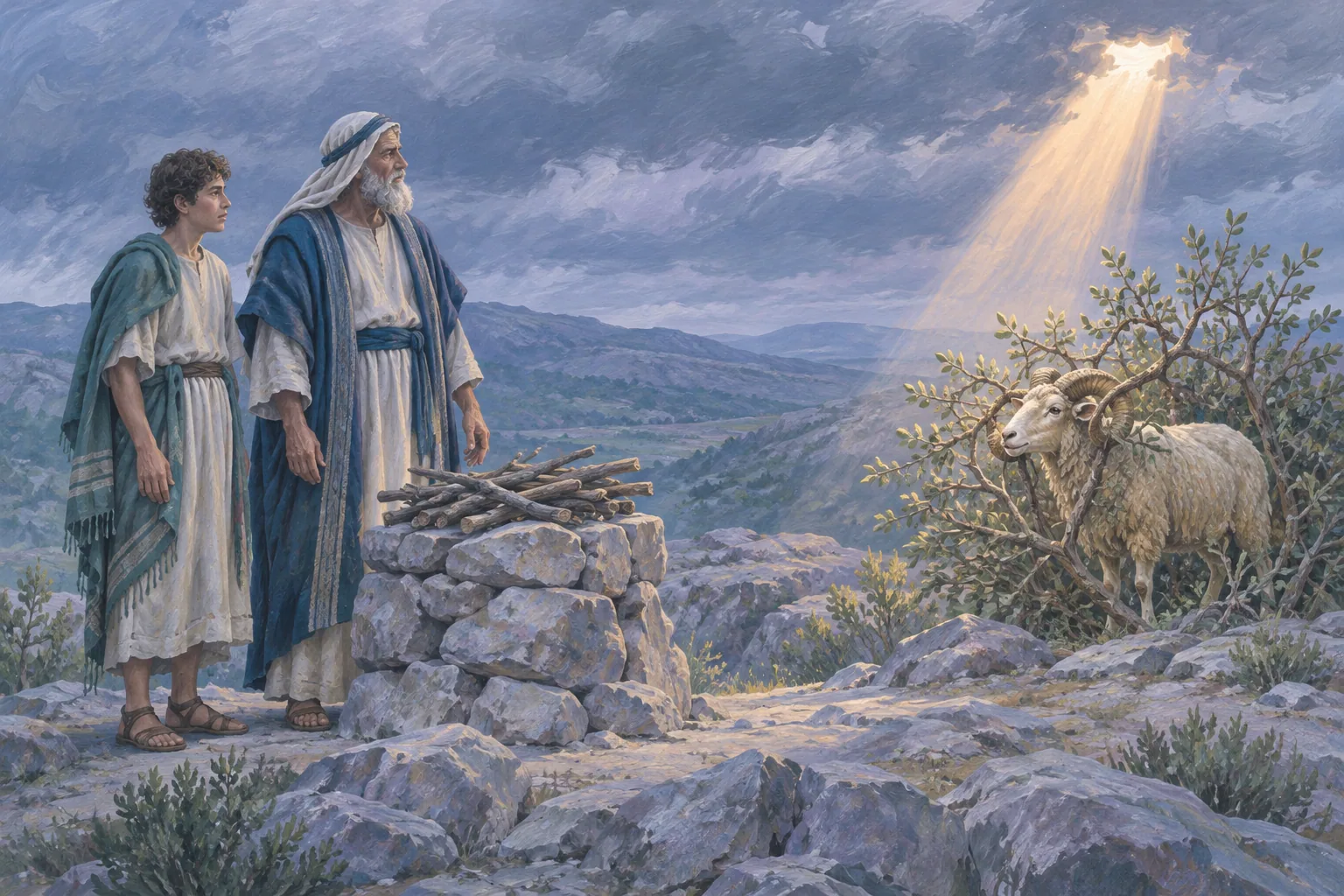
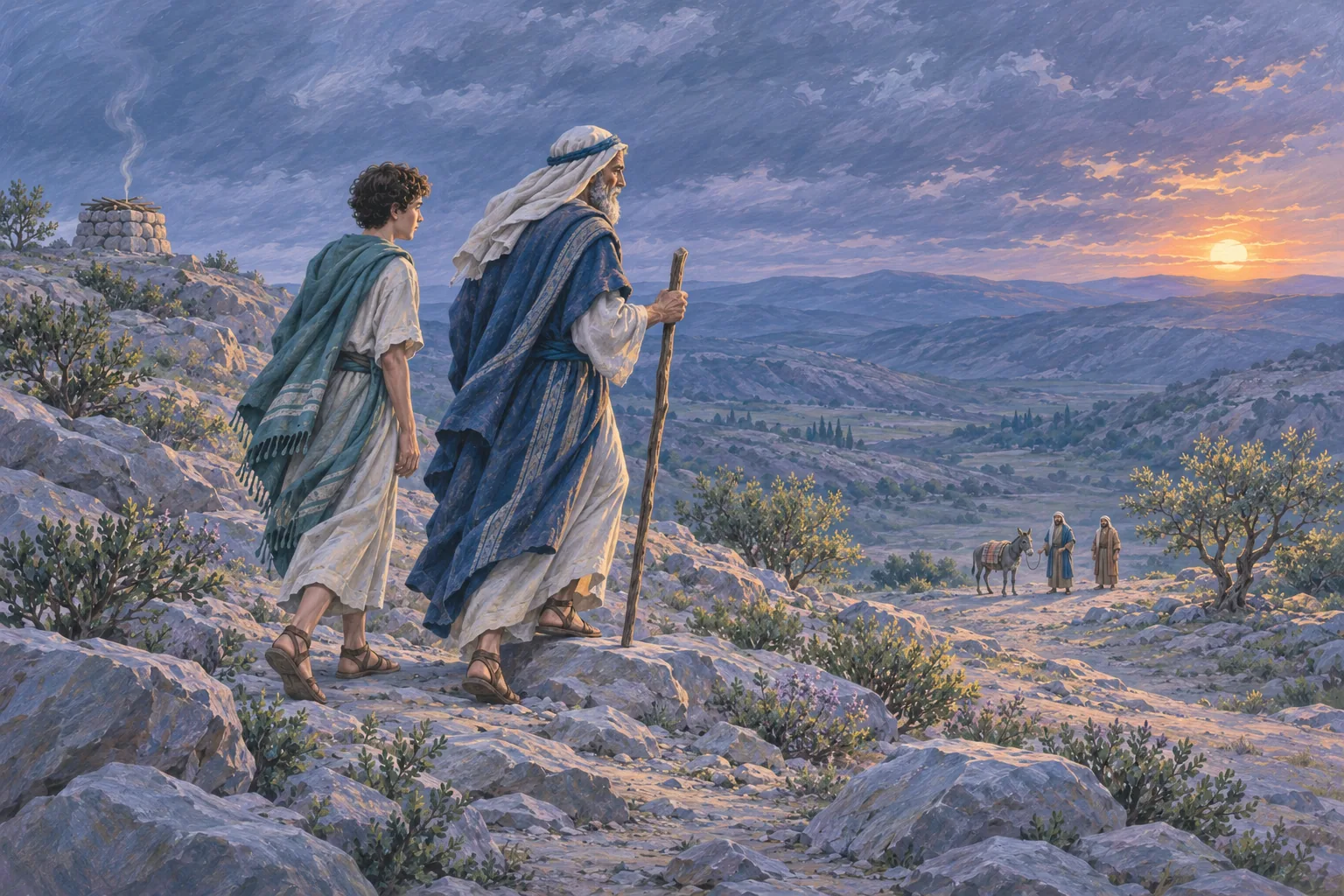
When they arrive, Abraham builds an altar, arranges the wood, binds Isaac, and lays him on the wood. Then he reaches out and takes the knife. At that moment the angel of the LORD calls from heaven, saying his name twice, and again Abraham answers that he is ready to listen.
The call is clear: “"Do not lay your hand on the boy," said the messenger. "Do not do the least thing to him. I know now how devoted you are to God, since you did not withhold from me your own beloved son."” (Gn 22:12). Abraham looks up and sees a ram caught by its horns in the thicket. He offers it in place of his son and names the place Yahweh-yireh.
A second time the angel of the LORD calls from heaven. The LORD swears to bless Abraham abundantly and make his descendants as countless as the stars of the sky and the sands of the seashore: “and in your descendants all the nations of the earth shall find blessing - all this because you obeyed my command.''” (Gn 22:18). Then Abraham returns to his two servants, they set out for Beer-sheba, and Abraham stays there.
Background in the Land of Moriah
Isaac was no ordinary son to Abraham. In his homily for the Second Sunday of Lent, February 23, 1997, when this story was the first reading, Pope John Paul II recalled that Isaac was the promised son, born in Abraham's old age. So, the Pope said, this sacrifice must have been the greatest a father could imagine.
The story is also remembered for its setting. Pope John Paul II mentioned a tradition that the place where Abraham was to offer his son is where the eternal Father accepted the offering of his only Son, Jesus Christ. It is a tradition, not a confirmed historical record.
The Meaning of Faith in Darkness
Pope John Paul II called this event the summit of Abraham's faith: through faith he emerged victorious from a trial that challenged that faith directly. Pope Francis describes Abraham living his faith like walking at night under a starless sky. Yet God himself stopped Abraham's hand, seeing his wholehearted readiness.
The Church also reads this story in the light of Christ. According to Pope John Paul II, Abraham's sacrifice can be seen as a prophetic sign of Christ's sacrifice: Isaac's sacrifice was not actually required, while Christ drank the cup of suffering to the last drop. So Isaac carrying the wood can be read as an early image of Christ carrying the cross.
For teenagers and young adults, what stays is Abraham's answer that God will provide. Some seasons feel dark: an unclear future, hard decisions, prayer that seems unanswered. The Catechism portrays Abraham as a man of silence who built an altar to the Lord at each stage of his journey. His prayer showed in the steps he kept taking.
At a glance
- Reading
- Genesis 22:1-19
- Form
- Event
- People
- Abraham · Isaac · The angel of the LORD · Abraham's two servants
- Places
- Land of Moriah · Yahweh-yireh · Beer-sheba
- Read at Mass
- First reading for the Second Sunday of Lent, with the Gospel of the Transfiguration (homily of Pope John Paul II, February 23, 1997) vatican.va
This story is retold by the Light of Saints editorial team from the Catholic edition of Scripture and the Church sources listed, with the help of AI, and checked by an editor. Some of the atmosphere and the characters' feelings are our portrayal. For the full text, read the passage in Scripture.
Take this story into your prayer.
Common questions
Why did God ask Abraham to sacrifice Isaac?
The Book of Genesis describes this event as God putting Abraham to the test. God himself stopped Abraham's hand because he saw his wholehearted readiness, and a ram was offered in Isaac's place.
How is the story of Abraham and Isaac connected to Jesus?
Pope John Paul II taught that Abraham's sacrifice can be seen as a prophetic sign of Christ's sacrifice. The difference is that the sacrifice of Isaac was not actually required, while Christ drank the cup of suffering to the last drop.
Where did Abraham go to sacrifice Isaac?
To one of the heights in the land of Moriah, and Abraham named that place Yahweh-yireh. Pope John Paul II mentioned a tradition that it is the same place where the Father accepted the offering of his Son, Jesus Christ.
What happened after Isaac was spared?
The angel of the LORD called a second time and announced the LORD's oath to bless Abraham and his descendants. Afterward Abraham returned to his two servants and stayed in Beer-sheba.
Context & sources
Gn 22:1-19
Scripture quotations are from the New American Bible © Confraternity of Christian Doctrine, Washington, D.C.
Published at www.vatican.va
Cited as a Church source; the source text remains its publisher's.
Published at www.vatican.va
Cited as a Church source; the source text remains its publisher's.
Published at press.vatican.va
Cited as a Church source; the source text remains its publisher's.
Free to copy and share. Please credit lightofsaints.com. Copyright