Te Deum
Traditional prayer of the Church. · ICEL (1975 Liturgy of the Hours / ICET text); the page does not state this
Bless someone else by sharing this prayer.
Free to copy and share. Please credit lightofsaints.com.
The Te Deum
You are God: we praise you;
You are God: we acclaim you;
You are the eternal Father:
All creation worships you.
To you all angels, all the powers of heaven,
Cherubim and Seraphim, sing in endless praise:
Holy, holy, holy, Lord, God of power and might,
Heaven and earth are full of your glory.
The glorious company of apostles praise you.
The noble fellowship of prophets praise you.
The white-robed army of martyrs praise you.
Throughout the world the holy Church acclaims you:
Father, of majesty unbounded,
Your true and only Son, worthy of all worship,
And the Holy Spirit, advocate and guide.
You, Christ, are the king of glory,
The eternal Son of the Father.
When you became man to set us free
You did not spurn the Virgin’s womb.
You overcame the sting of death,
And opened the kingdom of heaven to all believers.
You are seated at God’s right hand in glory.
We believe that you will come, and be our judge.
Come then, Lord, and help your people,
Bought with the price of your own blood,
And bring us with your saints
To glory everlasting.
Save your people, Lord, and bless your inheritance.
Govern and uphold them now and always.
Day by day we bless you.
We praise your name forever.
Keep us today, Lord, from all sin.
Have mercy on us, Lord, have mercy.
Lord, show us your love and mercy;
For we put our trust in you.
In you, Lord, is our hope:
And we shall never hope in vain
Latin text
Te Deum laudamus
TE DEUM laudamus: te Dominum confitemur.
Te aeternum Patrem omnis terra veneratur.
Tibi omnes Angeli; tibi Caeli et universae Potestates;
Tibi Cherubim et Seraphim incessabili voce proclamant:
Sanctus, Sanctus, Sanctus, Dominus Deus Sabaoth.
Pleni sunt caeli et terra maiestatis gloriae tuae.
Te gloriosus Apostolorum chorus,
Te Prophetarum laudabilis numerus,
Te Martyrum candidatus laudat exercitus.
Te per orbem terrarum sancta confitetur Ecclesia,
Patrem immensae maiestatis:
Venerandum tuum verum et unicum Filium;
Sanctum quoque Paraclitum Spiritum.
Tu Rex gloriae, Christe.
Tu Patris sempiternus es Filius.
Tu ad liberandum suscepturus hominem, non horruisti Virginis uterum.
Tu, devicto mortis aculeo, aperuisti credentibus regna caelorum.
Tu ad dexteram Dei sedes, in gloria Patris.
Iudex crederis esse venturus.
Te ergo quaesumus, tuis famulis subveni: quos pretioso sanguine redemisti.
Aeterna fac cum sanctis tuis in gloria numerari.
Versikel dan jawaban
V. Salvum fac populum tuum, Domine, et benedic hereditati tuae.
R. Et rege eos, et extolle illos usque in aeternum.
V. Per singulos dies benedicimus te.
R. Et laudamus nomen tuum in saeculum, et in saeculum saeculi.
V. Dignare, Domine, die isto sine peccato nos custodire.
R. Miserere nostri, Domine, miserere nostri.
V. Fiat misericordia tua, Domine, super nos, quemadmodum speravimus in te.
R. In te, Domine, speravi: non confundar in aeternum.
Meaning in brief
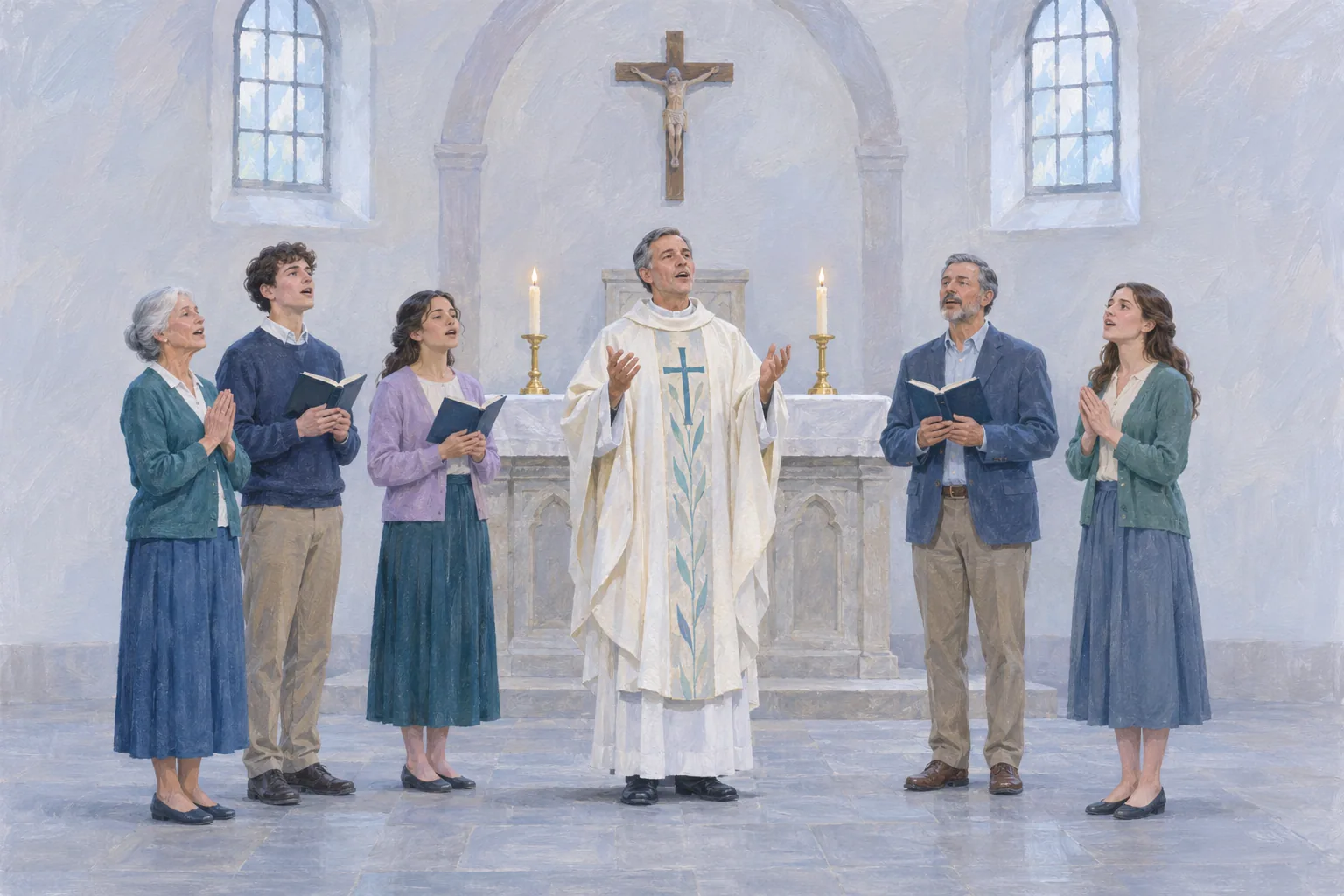
The Te Deum praises God the Father, the Son and the Holy Spirit together with all of heaven and the Church, echoing the cry "Holy, holy, holy" from Isaiah 6:3. The hymn then proclaims Christ's work of redemption and asks him to help his people, redeemed by his blood.
Intentions and hope
The faithful pray or sing the Te Deum to give thanks for God's blessings, for example at the end of the year, after an important event, or at great celebrations of the Church. What one may hope for is a heart that grows better at praising God and noticing his goodness in everyday life.
When and how to pray
- Pray or sing the Te Deum as an act of thanksgiving, alone or with others; standing is the usual posture when it is sung together.
- In the Liturgy of the Hours, the Te Deum is prayed at the end of the Office of Readings on Sundays outside Lent, on solemnities and feasts, and during the octaves of Easter and Christmas.
- By Church custom, the Te Deum is sung on December 31 to give thanks for the year that is ending, often at Evening Prayer I of the Solemnity of Mary, the Holy Mother of God.
- Recite it calmly and slowly, paying attention to the part that praises the Holy Trinity and to the petitions at the end.
Where it comes from
History
The Te Deum is a Latin hymn. It is not a translation from Greek; the Greek text is in fact a translation made in the West in the 9th century. [3]
About a dozen ancient manuscripts from Ireland name a "Bishop Nicet" as its author. The scholars G. Morin and A. Burn identified him with Nicetas of Remesiana. His is the name most often given, but the attribution is still debated, and some scholars place the hymn in the early 5th century. [3]
The earliest recorded liturgical use of the Te Deum is in southeastern Gaul, Milan and central Italy. From the 6th century, it was sung at the end of Sunday Matins, on the days when the Gloria was sung at Mass. [3]
One of the oldest manuscripts containing the Te Deum is the Antiphonary of Bangor, now kept in the Ambrosian Library in Milan. In 1958, Ernst Kähler argued that the hymn originally belonged to the Easter Vigil, at the close of the baptismal rite. This is a scholarly hypothesis, not a certainty. [4]
Sources & version
Text: ICEL (1975 Liturgy of the Hours / ICET text); the page does not state this. Checked word for word against the source on 2026-11-05.
- The Te Deum - Prayers - Vatican News
Text taken from www.vaticannews.va
Prayer text © ICEL (1975 Liturgy of the Hours / ICET text); the page does not state this; quoted with attribution and a link (owner decision K2, ADR 0067).
- Te Deum
Published by Encyclopedia.com (New Catholic Encyclopedia entry)
Cited as a factual source; the source text remains its publisher's.
- Te Deum laudamus
Published by Hymnology Archive
Cited as a factual source; the source text remains its publisher's.
- Te Deum Laudamus
Published by McClintock and Strong Biblical Cyclopedia
Cited as a factual source; the source text remains its publisher's.
Free to copy and share. Please credit lightofsaints.com. Copyright