Saint Francis of Assisi: From Bitterness to Joy
Saint Francis of Assisi, a rich youth, slowly converted; led by God to people with leprosy, he chose poverty in communion with the Church to follow Christ.
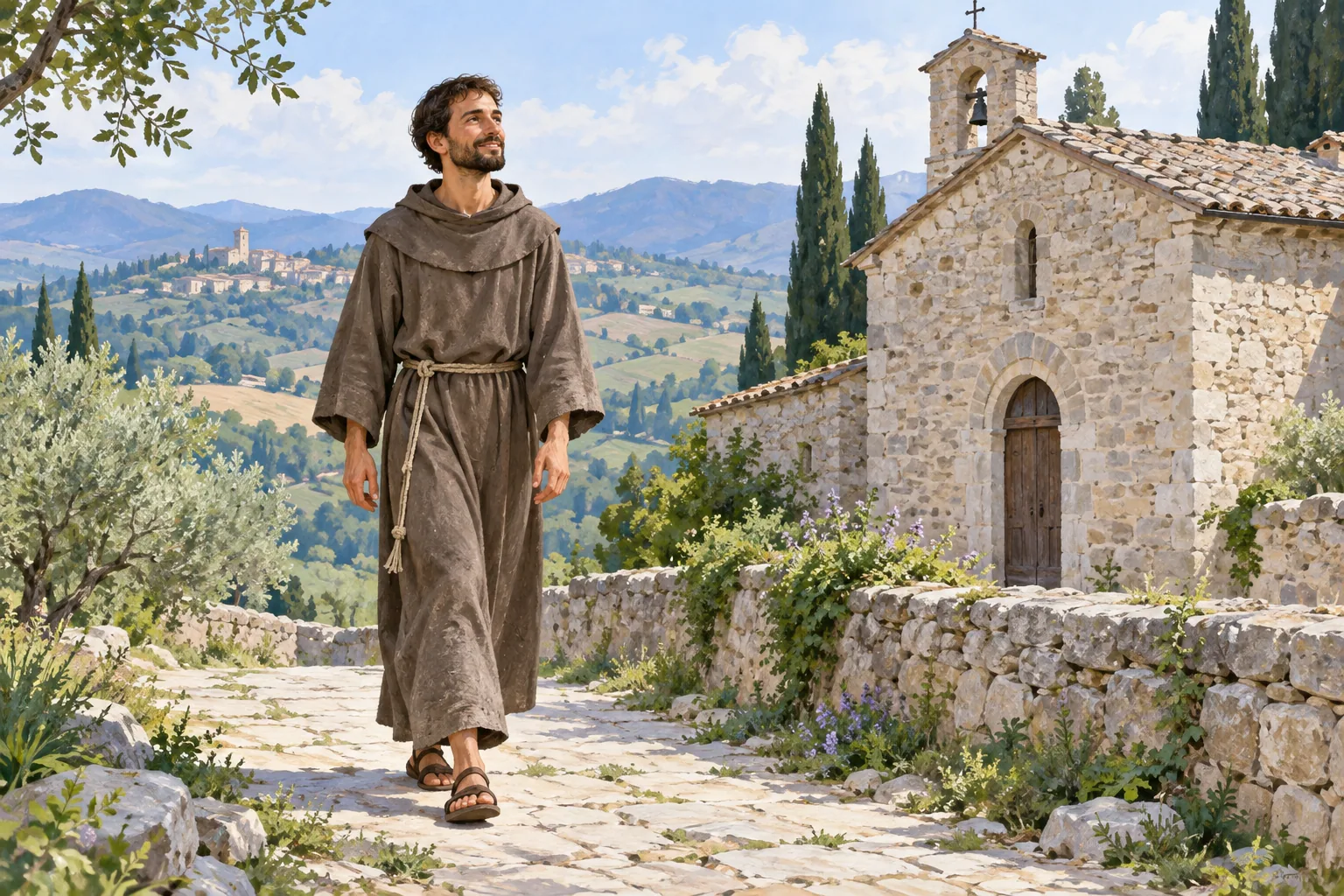
Francis grew up in Assisi as the son of a wealthy family. His father was a cloth merchant. His adolescence and youth were carefree, and he cultivated the chivalrous ideals admired in his time. At the age of 20, he took part in a military campaign.
Instead, he was taken prisoner, fell ill, and was then freed. After he returned to Assisi, his life did not change in an instant. His conversion was gradual. Little by little, he abandoned the worldly lifestyle he had been living until then.
The deepest change came through his encounter with people with leprosy. In the last months of his life, Francis compiled his Testament. As Pope Benedict XVI explains, there he recalled that the sight of them had once seemed bitter to him, and he regarded roughly the first 25 years of his life as a time spent in sin. Yet he testified that the Lord himself led him among them. What had been bitter was changed into sweetness for his soul and body.
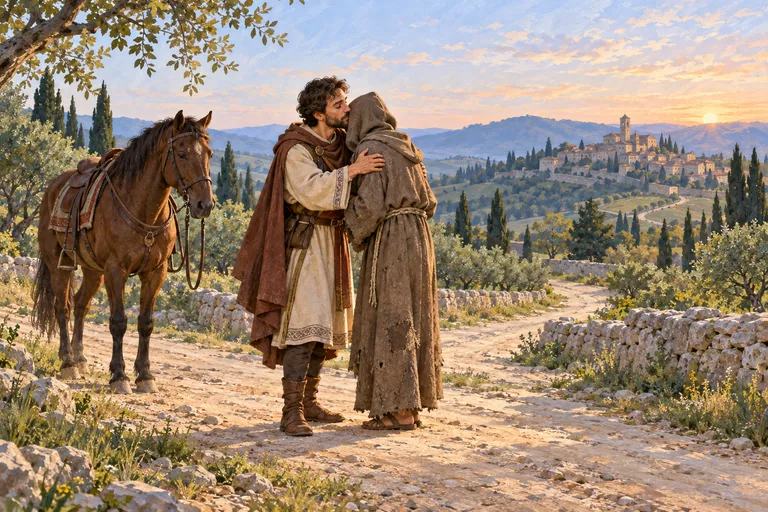
A famous story from that period, handed down by the tradition about his life, tells how Francis dismounted from his horse and gave the kiss of peace to a person with leprosy. Benedict XVI stresses that serving them was not merely a social kindness. It was a true experience of faith, moved by the initiative of God's grace and love. The people he had once avoided he now recognized as brothers to love.
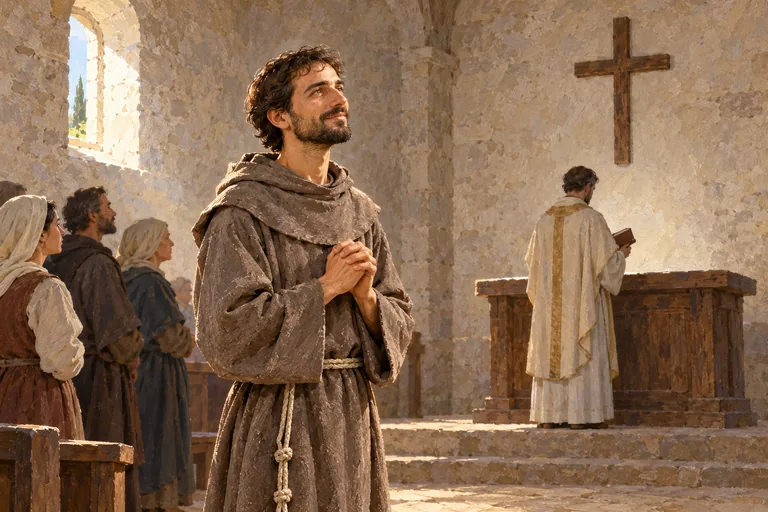
During that same period of conversion, according to the tradition recounted by Church sources, Francis prayed before the cross in the small church of San Damiano and experienced Christ's call to repair his Church. He responded by working with his own hands to repair the building of that small church. Later this call came to be understood as a deeper invitation: to renew Christ's own Church.
His generosity to the poor led his father, Bernardone, to reproach him. Before the Bishop of Assisi, Francis stripped off his clothes as a sign that he was renouncing his father's inheritance. According to the Vita Prima, cited by Pope Francis, Bishop Guido understood this act, immediately embraced him, covered him with his cloak, and from then on became his helper and protector.
Pope Francis interprets that event as a choice to be poor. In his view, it was not an ideological choice but a choice to be like Jesus and to follow him to the end.
After living for a time as a hermit, in 1208 Francis heard the passage of the Gospel of Matthew about Jesus sending out the apostles. He felt called to live in poverty and to preach. Several companions joined him. In 1209 he went to Rome to propose to Pope Innocent III the plan for a new form of Christian life. He always acted in full communion with the authorities of the Church.
From his love for Christ came love for others and for all of God's creatures; this sense of brotherhood inspired the famous Canticle of Creatures. Benedict XVI describes him as a joyful saint: his simplicity, humility, faith, love for Christ and goodness toward every person brought him gladness in every circumstance.
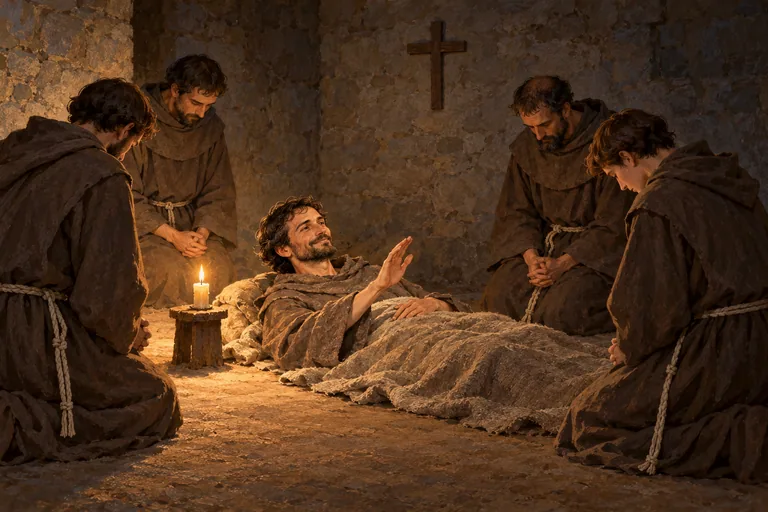
Francis died on the evening of October 3, 1226, at the Portiuncula. After blessing his spiritual children, he died lying on the earthen floor. Two years later, Pope Gregory IX entered him in the roll of saints.
- Birth
- Assisi, late 1181 or early 1182, into a wealthy cloth-merchant family
- San Damiano Cross
- According to tradition, probably in 1205
- Meeting with the Pope
- 1209, with Pope Innocent III in Rome
- Death
- Evening of October 3, 1226, at the Portiuncula
- Church status
- Saint; entered in the roll of saints by Pope Gregory IX two years after his death
Bring this story into your prayer.
Context & sources
General Audience, January 27, 2010, paragraphs: on Francis's death; opening of the biography; on the period of conversion; on the San Damiano Cross; 'Let us return to the life of St Francis'; on the years 1208–1209; on charism and the Church; General Audience, January 27, 201
Official Vatican URL supplied in approved brief. Research snapshot; rights and final paraphrase require human review.
Homily of Benedict XVI, Assisi, June 17, 2007, section on Francis and David
Official Vatican URL supplied in approved brief. Research snapshot; rights and final paraphrase require human review.
Homily of Pope Francis, Assisi, October 4, 2013, point 1; Homily of Pope Francis, Assisi, October 4, 2013, point 3
Official Vatican URL supplied in approved brief. Research snapshot; rights and final paraphrase require human review.
Written address of Pope Francis, Room of Renunciation, Assisi, October 4, 2013
Official Vatican URL supplied in approved brief. Research snapshot; rights and final paraphrase require human review.
Free to copy and share. Please credit lightofsaints.com. Copyright