The Good Samaritan: Stopping to Become a Neighbor
In Luke 10:25-37, Jesus answers a scholar of the law with the story of a Samaritan who stops to help a man beaten by robbers on the road.
Bless someone else by sharing this story.
Free to copy and share. Please credit lightofsaints.com.
Key idea
The parable of the Good Samaritan in Luke 10:25-37 tells of a man robbed on the road from Jerusalem to Jericho: a priest and a Levite pass him by, but a Samaritan stops and cares for him. Jesus turns the scholar's question about who his neighbor is into a call to be neighbor to anyone suffering, because love of God must show itself in deeds.
Luke records a conversation that begins with a test. “There was a scholar of the law who stood up to test him and said, "Teacher, what must I do to inherit eternal life?"” (Lk 10:25) A scholar of the law was someone who studied the Law of Moses closely, and his question touches what matters most to every believer.
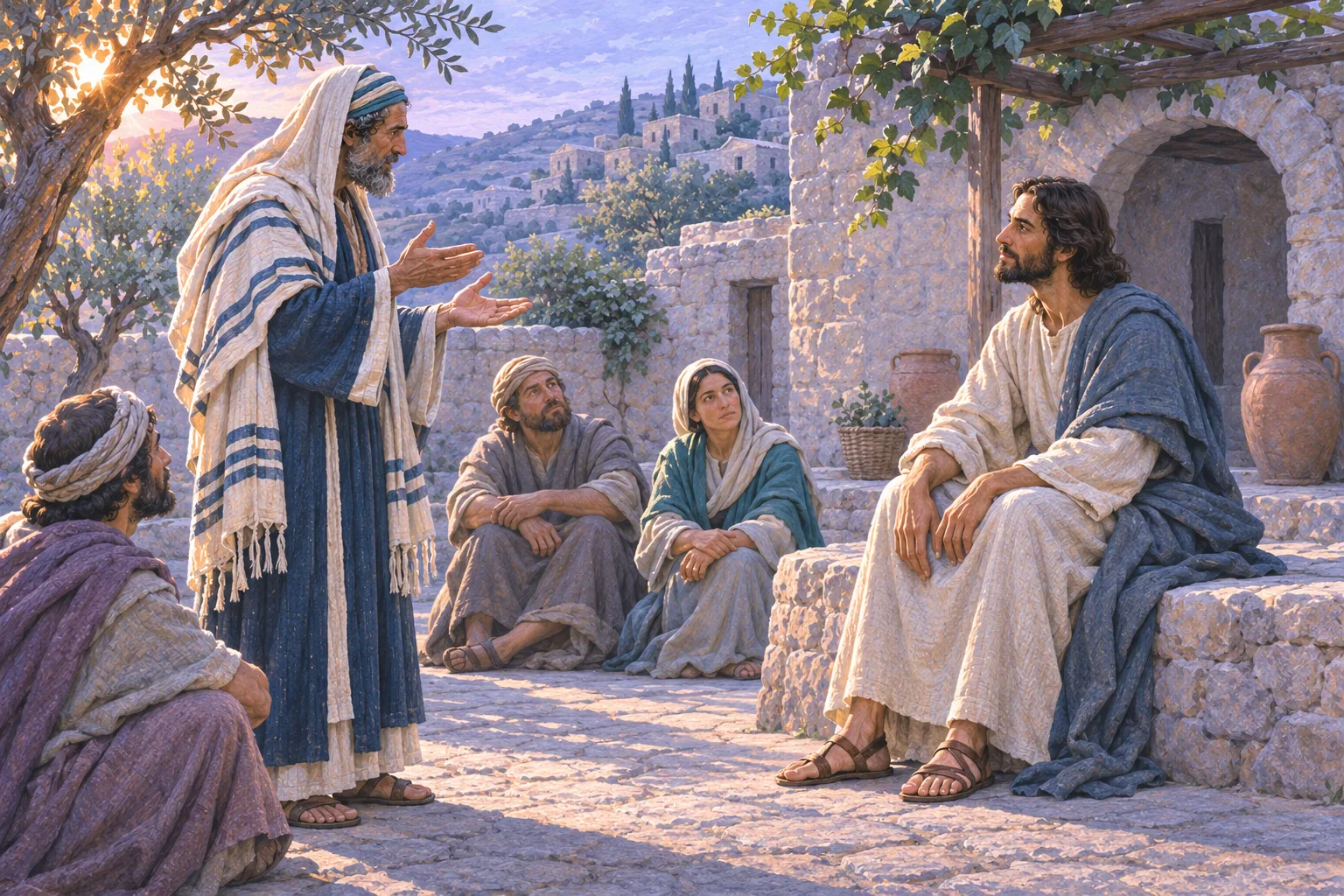
Jesus does not answer right away. He asks in return what is written in the law and how the man reads it. The scholar answers correctly: “He said in reply, "You shall love the Lord, your God, with all your heart, with all your being, with all your strength, and with all your mind, and your neighbor as yourself."” (Lk 10:27)
Jesus affirms him: “He replied to him, "You have answered correctly; do this and you will live."” (Lk 10:28) But Luke writes that the man, wishing to justify himself, asked who his neighbor was. Perhaps he hoped for a clear line: whom he was bound to love, and whom he could leave alone.
Jesus answers with a story. A man was going down from Jerusalem to Jericho. Along the way he fell victim to robbers. They stripped him, beat him, and went off leaving him half-dead. Imagine that lonely road, and a man lying there helpless, perhaps no longer able even to call for help.

By chance a priest was going down that road. He saw the man but passed by on the opposite side. Then a Levite came to the same place. He too saw him and passed by on the opposite side. The text gives no reason. It records only this: they saw, but they did not stop.
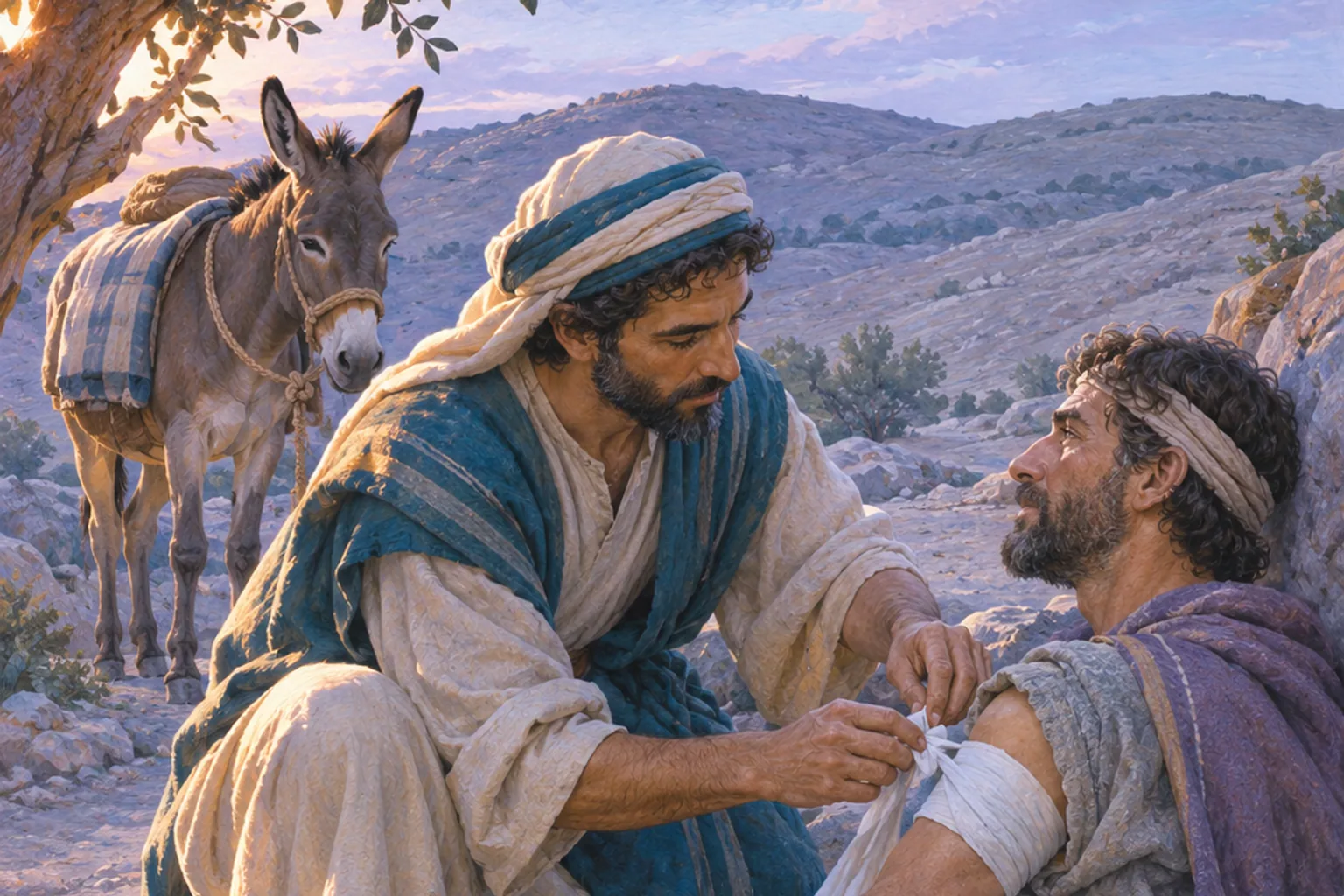
Then a Samaritan traveler came along. For Jesus' listeners this character was a surprise, because some people at that time looked down on Samaritans. When he saw the wounded man, he was moved with compassion. Perhaps he also knew the road was dangerous, yet he did not keep his distance.
He approached, poured oil and wine over the man's wounds, and bandaged them. He lifted him onto his own animal, brought him to an inn, and cared for him. The next day he gave two silver coins to the innkeeper. He asked him to look after the man and promised to repay any extra cost on his way back.
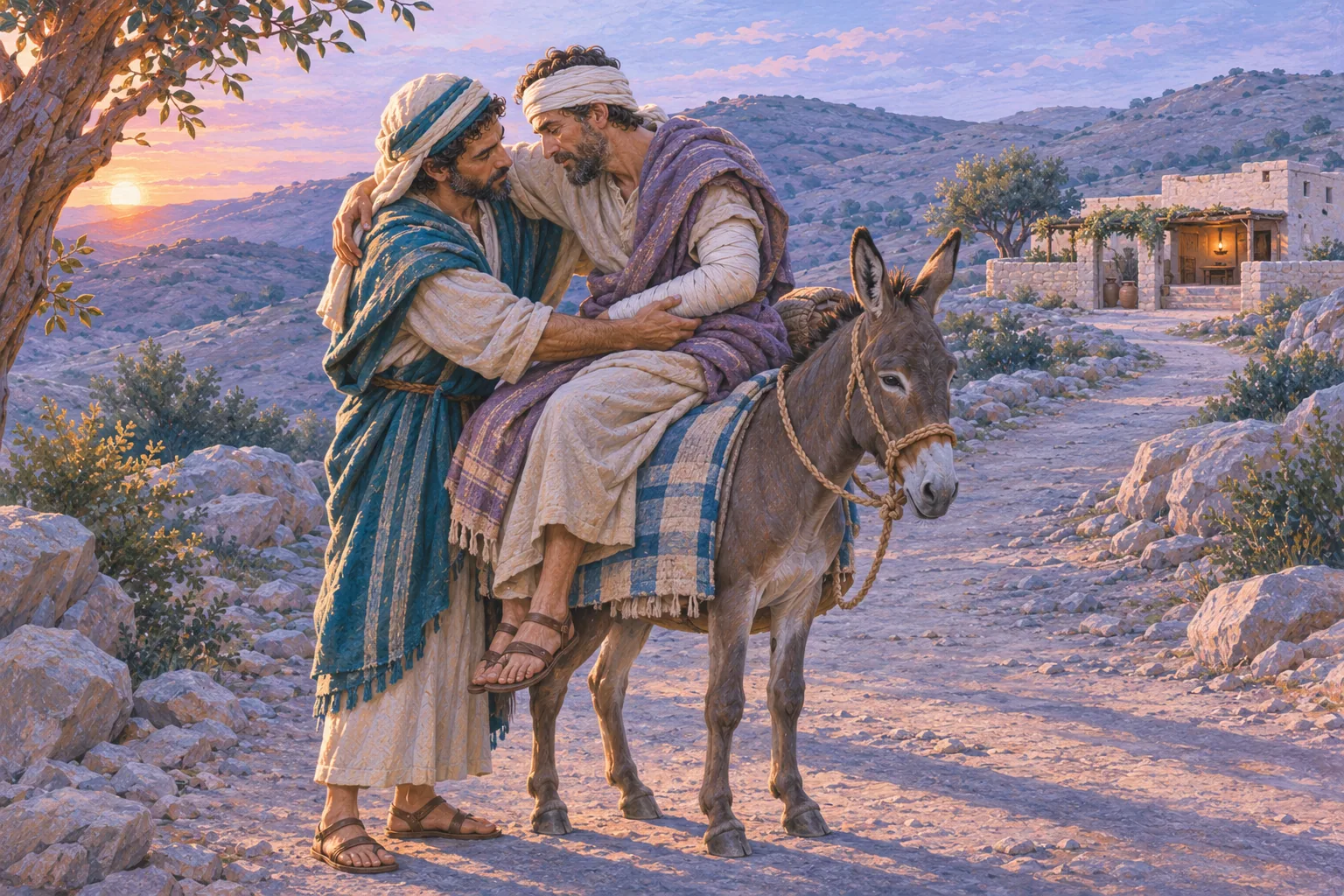
Then Jesus asked the scholar which of the three had been neighbor to the robbers' victim. The answer was clear, and Jesus closed the conversation with a short command: “He answered, "The one who treated him with mercy." Jesus said to him, "Go and do likewise."” (Lk 10:37)
The Jericho Road and the Samaritans
This parable is found in the Gospel of Luke, chapter 10, verses 25 to 37. It is a story Jesus told, not a report of an event, so its characters have no names. Pope Francis explains that the priest and the Levite were figures connected with worship in the Temple, and that the Law of the Lord required people to help in such a situation.
The choice of the third character is startling. Fratelli Tutti notes that for some Jews of that time, Samaritans were looked down upon, considered impure, and not counted among those who should be helped. The encyclical also recalls that Jesus himself was a Jew, and it was he who completely transformed that way of seeing.
Becoming a Neighbor to Everyone
Pope Francis teaches that those who faithfully come to the house of God do not automatically know how to love their neighbor, and that there is no true worship unless it is expressed in service to others. He even insists that ignoring human suffering means ignoring God. Love of God and love of neighbor, as in the scholar's answer, cannot be separated.
Jesus turns the scholar's question around. He does not say who deserves to be called a neighbor; he asks who acted as one. Fratelli Tutti puts it this way: we no longer say that we have neighbors to help, but that we ourselves must become neighbors to others. The encyclical also invites Christians to recognize Christ himself in abandoned or excluded brothers and sisters.
For teenagers and young adults, the road to Jericho might be a school hallway, a group chat, or their own home. There is the friend being bullied, the younger sibling who is overwhelmed, the elderly neighbor who rarely has visitors. Like the Samaritan, the first step is deciding to stop and come closer, then acting in real and faithful ways, without waiting for recognition or thanks.
At a glance
- Reading
- Luke 10:25-37
- Form
- Parable
- People
- Jesus · Scholar of the law · The man who fell victim to robbers · Priest and Levite · Samaritan · Innkeeper
- Places
- Jerusalem · Jericho · Inn
People in this story
 Saint Teresa of Calcutta: Faithful Service in Inner DarknessSaint Teresa of Calcutta (Mother Teresa): Jesus' cry of thirst moved her to serve the poorest, and she prayed faithfully through years of inner darkness.
 Saint John Bosco: A Priest Present for Street YouthThe story of Saint John Bosco, a priest who accompanied street boys through the oratory, schools, and workplaces, so their faith and future grew together.
This story is retold by the Light of Saints editorial team from the Catholic edition of Scripture and the Church sources listed, with the help of AI, and checked by an editor. Some of the atmosphere and the characters' feelings are our portrayal. For the full text, read the passage in Scripture.
Take this story into your prayer.
Common questions
Where is the Good Samaritan in the Bible?
The parable is in the Gospel of Luke 10:25-37. The story itself begins at verse 30, after the scholar of the law asks who his neighbor is, and it ends with Jesus' command in verse 37.
Who did the Good Samaritan help?
He helped a man going down from Jerusalem to Jericho who had been robbed, beaten, and left half-dead by robbers. He bandaged his wounds, brought him to an inn, and paid for his care.
Who are the characters in the Good Samaritan?
Jesus' story includes the man who was robbed, the robbers, a priest, a Levite, a Samaritan, and the innkeeper. Outside the story are Jesus and the scholar of the law who questioned him.
Why didn't the priest and the Levite help?
Luke gives no reason; he only records that both saw the man and passed by on the opposite side. Pope Francis stresses that the Law of the Lord required them to help, yet both went by without stopping.
Why is it called the Good Samaritan?
The word good does not appear in Luke's text. The Good Samaritan is the traditional title used by the Church and the faithful for this parable.
Context & sources
Lk 10:25-37
Scripture quotations are from the New American Bible © Confraternity of Christian Doctrine, Washington, D.C.
Published at www.vatican.va
Cited as a Church source; the source text remains its publisher's.
Published at www.vatican.va
Cited as a Church source; the source text remains its publisher's.
Published at www.usccb.org
Cited as a Church source; the source text remains its publisher's.
Free to copy and share. Please credit lightofsaints.com. Copyright